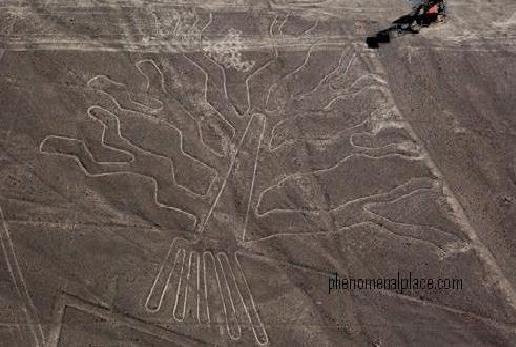
No matter how many places you go, Nazca lines (or Nasca) the weirdest and the most perplexing sight in the world. These figures were drawn by Nazca tribes around the time of the birth of Jesus Christ, and sometimes ranging over six hundred feet wide.
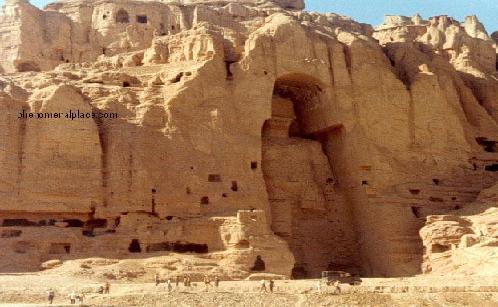
When the Buddhas of Bamiyan were destroyed, the Taliban Muslims were shocked to find what was beneath the statues. Behind the statues were around 50 caves which was used (once upon a time) as a dwelling place for buddhist pilgrims.
with more than 200 acres in land, the temple is carefully safeguarded by a moat. The sheer size of Angkor Wat will make you speechless. It was built in the honor of Vishnu, a hindu god. The design is based on Mount Meru, which is the mythical abode of Devas (Hindu Deities).
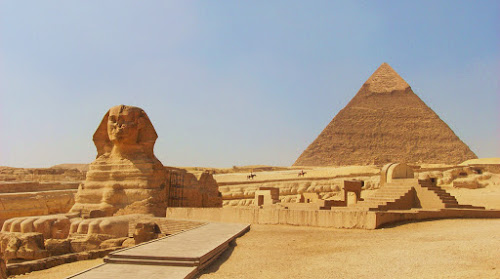
A Pyramid made of more than 2 million stones each weighing a ton, 4600 years ago. Unsolved mysteries of the Giza Pyramid, the interior virtual tour and fun facts! Click Now!
A country of over 330 islands, over two thirds of them are uninhabited. The scenic beauty is unparalleled, and it is the best place to go whether you want to relax, or have fun round the clock!
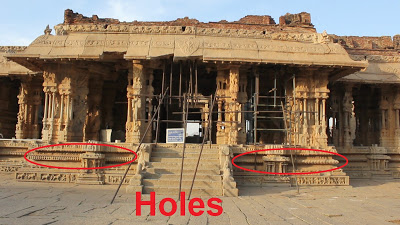
Hey guys, I am at the ancient Vitthala
temple in Hampi, and I just found out - there are strange holes drilled all around
the temple. It appears that no one has
noticed them, because they are not easy to find, unless you examine these walls
very closely. Watch the video below or read on.
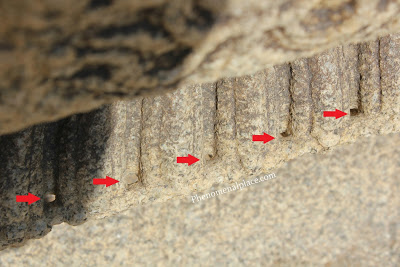
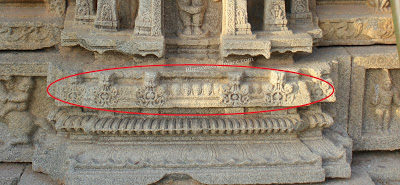
These series of holes are just about a centimeter wide. How did ancient builders drill these holes on granite,
which is one of the hardest rocks in the world? Today,
we use diamond tipped drill bits to create such holes on granite, but how was
it done in ancient times? But there is something
much more fascinating. Directly above this series of holes, we can see another
row of holes, a little bit bigger than the ones below. And there is a third row of holes right above this as
well, making the pattern much more complex.
But the most important question
is not how they drilled these holes, but why? Why
were these holes drilled all around the temple? Archeologists
say these were created for mere decoration, for
simple reasons like placing flowers or incense sticks all around the temple, but
these theories are not convincing.
Is there a way to find out if these holes
were made for mere decoration or if they
were an important part of the temple's design? See,
the ancient builders were extremely intelligent, they predicted these structures would be destroyed in the future by
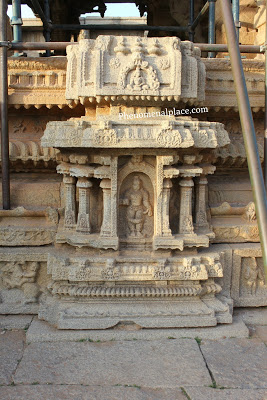
human beings. So they created a small 3d model of the temple within the temple
itself which details the most important aspects of the temple.
Here you can see that this model shows how the original
temple looked before it was destroyed by invaders. It was complete, with
multiple levels and finished with these objects called Kalasha which is how a
finished temple would look. But why am I
randomly showing you this model, while discussing about the holes in the temple?
Because, if these holes around the temple were carved for a very important
reason, the 3d model would also have these
holes. If they were drilled for mere
decoration, it won't be detailed in the model because the model only shows you
the most important features of the temple. So, I examined this model to see
if there are any holes carved on it, and I find exactly what I am looking for.
Here are a series of very minute holes carved in the model, these holes are actually just 1 millimeter wide. I think I have just discovered the smallest holes ever
drilled in ancient times. I mean, 1 millimeter holes on granite, created by
ancient builders - How is something like this even possible without the help of
machines? Remember, this whole city of Hampi
is full of evidence about ancient machining technology and I showed you how they used lathe machines in my
previous post.
So these minute holes on the
model prove that the holes were not created for mere decoration, but an
important part of the temple's design. But the big question that needs to be
answered is this: Why were these holes drilled all around the temple? Remember, I have shown you something very similar in Brihadeeswaratemple which was built a thousand years ago,
and this structure also has these minute
holes all around its base. Why do these ancient temples have minute holes
drilled all around the base? To understand this, we have to examine
what ancient temples actually represent. You might wonder why ancient Indian
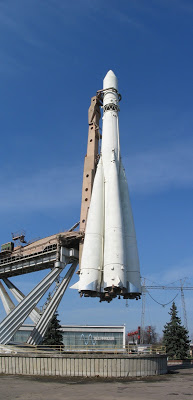
temples always look like rocket spacecraft,
well they were in fact designed specifically to
look like spacecraft.
The main structure
inside any temple complex is called Vimana, which
actually means aircraft or spacecraft. All Hindu temples have this
Vimana, which is always aerodynamically shaped. This
structure at Hampi has been destroyed, but from the model, we can clearly see
that this Vimana is also aerodynamically shaped with multiple levels.
If you look at the base of a modern day rocket, you can see
something very fascinating. They always have multiple holes at the bottom. These holes are called
exhaust nozzles, and these multiple holes are important for balancing and
changing the direction of the rocket. These
multiple holes are the reason why well-designed rockets go straight up and follow
the desired path, while home-made rockets with just one hole will almost never do that. Without going into too many
details, unlike home-made rockets which use fuel in just one chamber, advanced rockets make sure the fuel is distributed into
many small channels. And we can see the same
design on this temple as well. I am pouring
water, but assume that this is fuel and watch what happens. The fuel will be distributed though the bigger holes on
top, and each bigger hole actually has a separator in the middle, which will
make the fuel into 2 streams and these 2 streams will be channeled into the
smaller holes at the bottom. So, imagine what happens when fuel is released
from the center of the Vimana, there would
be thousands of fuel streams distributed all around the structure, which will
create a very balanced propulsion. Of course, these
structures are megalithic models of actual spacecraft. Now we can understand why the holes are so important,
that they were drilled even on the miniature model. Once we realize that this Vimana is a rocket model, we can start
understanding many different carvings around it. We can see lions breathing
fire right next to these holes.
But why are the flames going down instead of
going up? Light a candle and the fire will point up, now invert the candle and the flame will still
point up, because flames will always point
up. The only way for fire to point down is by
creating fuel powered thrust, just like a rocket. You can see the same carvings of fire breathing lions in
Mahabalipuram, and you can see a multi-stage rocket carved with all the
details.
So, what do you think? Why were these holes carved all around
the Vitthala temple? Is there also a connection with the musical pillars of Hampi? Please let me know your thoughts in the comments
section.
Hey guys, this is the ancient
site of Hampi that has been abandoned for at least 500 years, and here we can
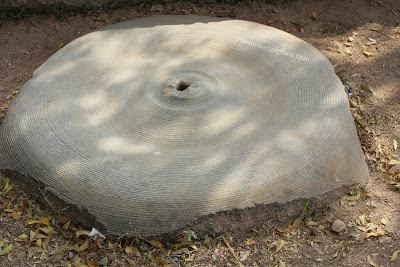
see this rock that shows solid evidence of machining technology. These perfect circular
marks on this rock can be produced only with machines.
This process is called
facing, and we use the same technology today using lathe machines. It is
covered with dirt when I found it, so I cleaned it up. Now, If you look at
these circles, they are perfectly concentric and there is no deviation, no
chipping in the rock, very similar to modern day technology.
The rectangular slot in the center proves that this rock
was machined using lathe technology. So,
how was this created at least 500 years ago, at a time when historians claim there
was no such technology? Were ancient
builders using high tech machines many centuries ago, just like today? If this
is true, we should not only find finished products like this circular rock,
but we should also find the entire mechanism that was able to create
this finished product. Is it possible that the entire mechanism, the lathe
itself can be found in the same area?
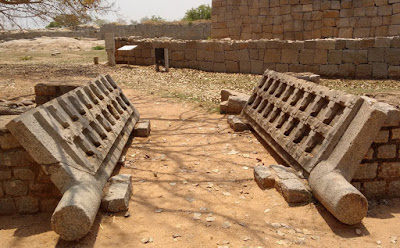
Now, if we take a step back and
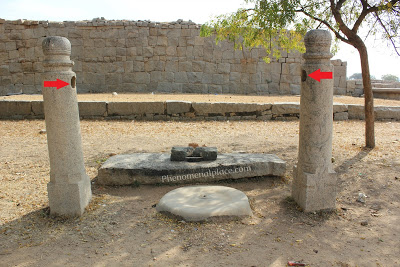
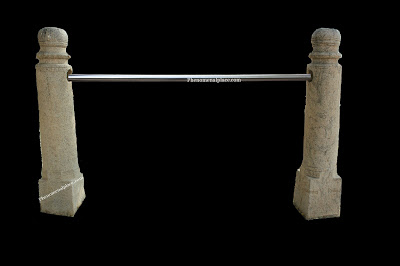
look at the entire picture, it has some very interesting components. It has two
posts with circular holes near the top, which obviously means that a
cylindrical rod was inserted between them, like this.
This is a simple model that I am recreating, which I will
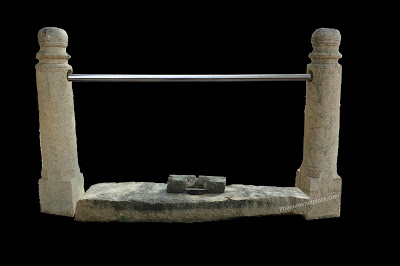
show side by side, so you can understand this better. Nearby, we can see a long rectangular slab, with a hole
in the center. When I measured the length of the slab, it matches exactly with
the distance between the two posts. What
does this mean? This means that the slab
would fit perfectly between these posts. I am
using this green rectangular styrofoam block which represents the slab in my
model. So, the set up would look like this.
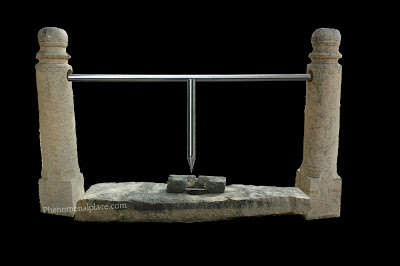
If a metal tool was placed on
this cylinder, pointing downwards, it looks like a modern day vertical lathe
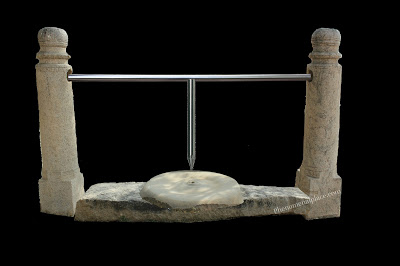
machine. I am going to use a pen for the metal tool in my model. This rectangular slab would be the base plate on which circular
rocks could be placed and machined.
Here is
a simple round object which represents the circular rock and I place it on the
rectangular slab, and if I rotate the circular rock, and lower the tool from
the top, we can create these identical tool marks.
See the similarity of the circles between this model, and
the actual rock. My model has not rotated on a perfect axis, so you see
that the circles are not as good, but the work of ancient builders was perfect.
This set up actually proves that ancient people
used vertical lathe technology, at least 500 years ago. See the video to understand this.
What's even more interesting is
that you can see some circular wear and tear on the base plate as well. Look at the base plate, you can see these half circular
marks caused by the rotating objects which were placed on top of it. The other
half shows no such tool marks, because these marks were created by accident, by
friction from the rotating objects placed above. You can see the same marks
beginning to form on my model as well.
All these evidences clearly prove that machining
technology, specifically vertical lathe technology was used in India, at least
500 years ago, and some archeologists even say this site was built 2300 years
ago. So, I think I have just discovered the
oldest machining set up, known to mankind,
and it is lying in plain sight, abandoned and covered in dirt.
So, why did ancient builders need
this type of advanced technology? What did
they create using this technology? Is it
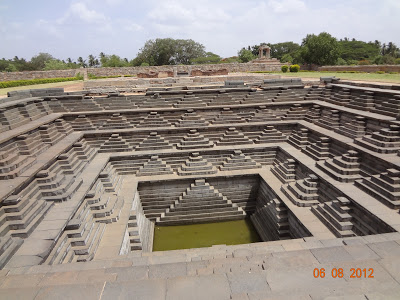
possible to find the products of this machining in the same site? Here is the majestic well nearby, created with pyramid shaped
steps all around, with machining perfection. Archeologists
say these were created with hard labor, chisels and hammers. But is such a precision possible with simple tools?
Is it possible, that these were made with machining
technology? Were many of the inexplicable
megalithic structures in India, made with machines? Remember, I showed you the machine made pillars at Hoysaleswara temple in a previous post.
But In this abandoned site of
Hampi, we can find a lot more strange
stone artifacts than any other temple. Here we can see two massive doors
created out of solid granite. Again, they
look like they have been created with machines.
But
there is something much more interesting, these doors were not created for mere
decoration, these stone doors weighing 10 tons each, were used as actual doors in ancient times. There are hinges for swinging the door, and even slots
for locks. Did ancient builders use rocks
for everything, just like how we use metals and wood today? Today most of the things we use like doors and furniture
are made with machines. Modern buildings are
also created with machines, with very little manual labor. Did ancient people build temples and other structures the
same way, but used rocks for everything?
So, what do you think? Did
ancient builders use machines many centuries ago, just like today? If they did not use machines, how do you explain these
circular tool marks, lathe setup and megalithic structures finished with such
precision? Please share this post with your friends, because I
think we have just found the world's oldest lathe technology.
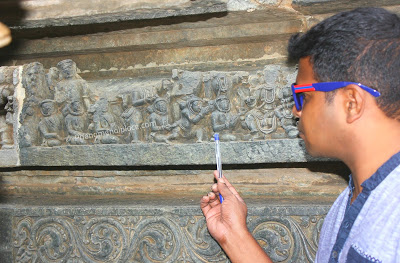
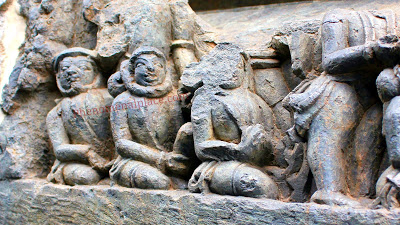
The Hoysaleswara Temple at Halebeedu has a very strange carving: there are figures which look very similar to modern day
astronauts. Watch the video below or read on.
They are wearing helmets which
cover their heads completely, and you can
see that each person is wearing protective gloves in his hands, notice the
cuffs of the gloves. If you observe closely, we can even see some of them have
wires that go from one side of the helmet and hooked up to a spherical device
at the back of the helmet. If you compare
this carving with modern day astronauts, the similarity is uncanny. Yet, these
carvings were created at least 900 years ago, some even say this temple was
built many thousands of years ago. The
question is, does this carving actually show astronauts, or does it depict something else?
No one has seen these carvings because they are hiding in a secret corner
I have asked several Historians
and Archeologists about this carving and they tell me that till date, nobody has been able
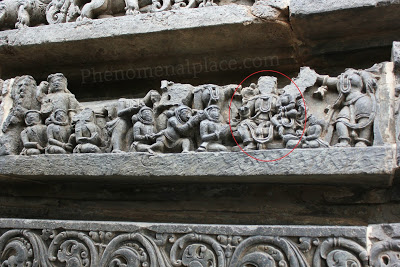
to decode this carving. Why? The reason is, Foreign Invaders have destroyed the top
part of this carving, specifically this particular figure who is the main character
in this carving. If you observe carefully, this figure is seated on a
throne, and the astronauts are on the floor begging him. The crouched positions
and hand gestures of the astronauts confirm this, but until we identify the
central figure, we cannot determine what's going on.
Who is this God who has been disfigured by Foreign Invaders?
So, let's observe this carving very
carefully, and see if we can find out who he is, for the very first time. On
his shoulder, we can see the outline of a circular weapon called Chakra, which
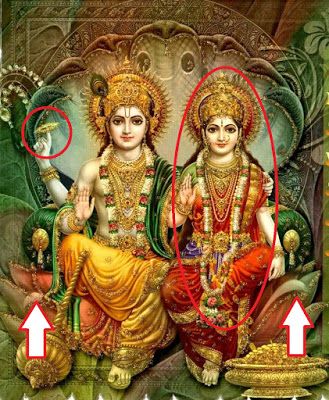
belongs to Lord Vishnu. You can see a female
figure sitting on his lap, and Vishnu is often portrayed with his wife Lakshmi
on his lap. This is definitely Lord Vishnu,
because his throne is shaped in the form of a lotus flower, and Vishnu is the God usually depicted on lotus flowers.
I wonder why no one observed these clues to find the
answer until now.
Modern day depiction of Vishnu with Chakra, Lakshmi & Lotus Throne
So, now that we know that this is
Vishnu, let's try to decode who these astronauts
are. In the ancient Indian texts, this scene
is clearly described. There are two groups
of deities at war with each other: Devas and Asuras. The Devas are unable to
defeat the Asuras, so they travel to a
planet called Vishnulokha, and beg Lord Vishnu
to help them. This carving perfectly fits
the scenario of Devas begging Vishnu for help. Today historians tell us that
all these stories are just mythology - Devas
traveling to other planets thousands of years ago, that would be impossible because there was no technology
for space travel at that time.
Closeup of Carvings show remarkable similarity to Modern Day Astronauts
But this carving shows that such
a scenario actually happened: Because, it
shows Devas as astronauts with helmets, wires and gloves, just like modern day
astronauts. What's even more interesting, the Devas are carved without these astronaut
suits when they are on earth. They are depicted with helmets, wires and gloves
only when they traveled to the other planet called Vishnulokha. If space travel
was not possible in ancient times, how can we explain sculptors carving the
Devas with remarkable similarity to modern day astronauts?
Ancient Indian Temples are treasure troves full of incredible information that needs to be decoded. In Hoysaleswara temple alone, we can see evidence of machining technology, carving of a telescope and even an Egyptian sculpture. All these clues prove that ancient India once had a very advanced technology which has been lost now.
So, what do you think? Were Indian
Gods real? Or were they merely fictional
characters as Historians claim? Please let
me know your thoughts in the comments section.
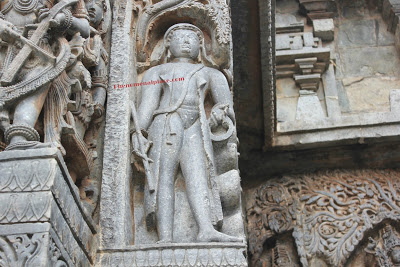
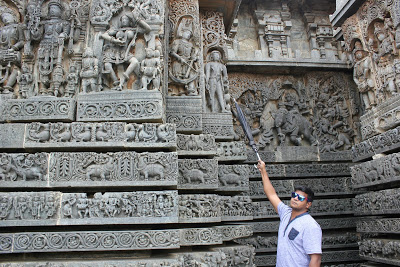
There is a very strange carving in Hoysaleswara Temple: an ancient Egyptian.
You can see that the clothes he is wearing and the
tools he is holding are completely different from all other carvings in this
temple.Watch the video below or read on.
In fact, many historians agree that this is an Egyptian figure but have no idea how it has been carved in India, which
is in a totally different continent. Mainstream archeologists say this temple
was built about 900 years ago, although locals say it has been in place for many
thousand years.
If we compare this carving, with
carvings of other Indian humans and gods in this temple, it has many distinct
features. All Indian figures are shown with no clothes on the upper body, but
wearing plenty of ornaments. This figure is the complete opposite, it is shown
wearing a long coat but almost no ornaments. Most Indian figures are shown
wearing footwear, but this figure is barefoot, just like the ancient Egyptians
shown in paintings and carvings.
Now, if you look at this Egyptian figure, you
can see that beneath the long coat, he is wearing a loincloth, and this is
exactly what this carving also shows: A simple loincloth underneath the long
coat. Now, if we take a closer look at this figure, we can see that he is
wearing a headdress that reaches the shoulders. We know that this is a
headdress because we can see his real hair underneath the headdress. And this headdress also looks remarkably similar to the
ancient Egyptians, while all Indian figures in the same temple show completely
different hairdos.
All history books tell us that
ancient India was not connected to ancient Egypt, yet we see this Egyptian
figure in this temple. How is that possible? Remember, experts are telling us
that ancient India was isolated, it was not connected to other countries. Yet,
in another video, I have shown you a European carved in the ancient Brihadeeswara
temple. All historians repeatedly tell us that India was not connected to
Africa, yet I have shown you the carving of
a Giraffe in Konark Sun Temple, and Giraffes are only found in Southern
Africa. With all these evidences, is it possible that ancient civilizations around
the world were connected, just like how we are all connected today? Were they
using advanced technology like telescopes and even communication devices? How
else can we explain this Egyptian, along with the other carvings found in
ancient Indian temples?
But the most important question
is, why did Egyptians come to India? What was the purpose of their visit?
So, I began scanning this temple
to see if there were any more of this Egyptian carved among thousands of other
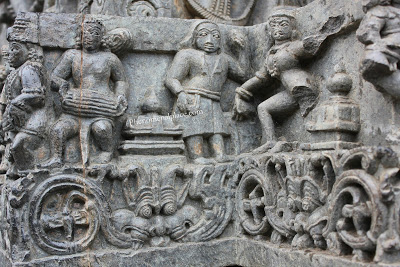
sculptures. There are two smaller carvings which show the same person. Below, he
is shown watching Indian musicians and dancers, suggesting that he was a
visitor from a royal family, and therefore, was being entertained.
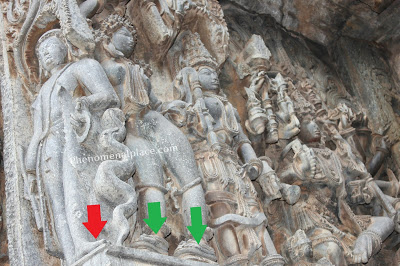
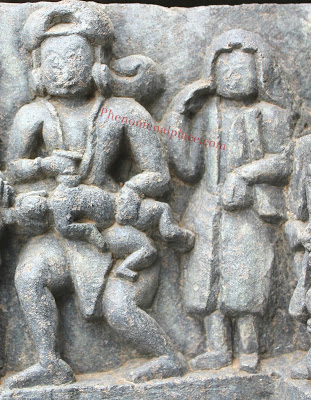
But there is
another sculpture which shows something remarkable: On the left, there is an Indian
man who has a child on his lap. What is strange is that he is using a dumbbell
like device on this child, and the Egyptian who is standing nearby is observing
this procedure. You can see that the dumbbell like device is placed on the left
side of the child's chest, exactly on top of the heart.
In modern medical
technology, in the last few years, we have developed something called a
cardiopump, to give CPR when someone has
a cardiac arrest.
It must be placed on top of the
heart, and it will revive the patient. Are we looking at the exact same technology, carved
in ancient times? Ancient Indian texts mention that other civilizations came to
India to learn advanced technology, specifically the field of medicine. Massive
Universities like Nalanda existed in ancient times and the ruins of these
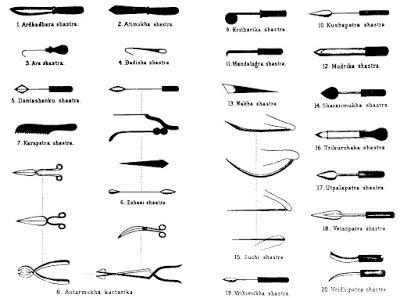
structures still exist today to confirm this. A text called Sushruta Samhita,
written at least 2700 years ago talks about advanced surgical operations, and
mentions a vast variety of surgical instruments.
Carvings of identical surgical
instruments are found in ancient Egypt. Carvings in Egypt clearly show this and
archeologists have even found remains of these metal surgical tools, proving
that surgery was done in ancient Egypt, just like India.
So, what do you think? Was India
and Egypt connected in ancient times? Did we have a sophisticated civilization with advanced
technology, thousands of years ago? Was the world connected back then, just
like today? Please let me know your thoughts in the comments section.
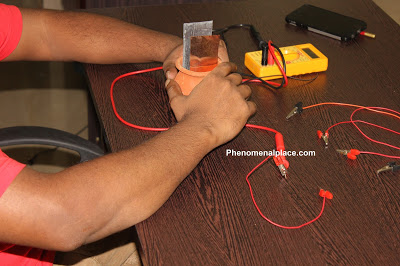
I have been recreating the electric battery, which was used in
Ancient India. This battery was described by a sage called Agastya who lived at
least 4000 years ago, and what I am making is according to what's being
described in the ancient text called Agastya Samhita. Watch the video below or read on.
This text, talks about
using an earthen pot as a container and using two types of metals: Copper and
Zinc. So, this is how the setup looks. If I test this with a voltmeter, you can
see there is no voltage so far. Now, the text mentions that sawdust must be put
in the container.
When we add sawdust in the container, the sawdust goes in
between the two metals, and makes sure they don't touch each other, or create a
short circuit. If we check the voltage now, we can see that it is already
producing 0.4 or xx volts. But the text mentions
adding yet another strange material to complete the battery: The neck of a
peacock. In the ancient Sanskrit text this material is mentioned asshikhigreeva, which
means the neck of a peacock. Many secret cults exist even today, and these
people still trying to recreate the battery using the actual neck of a peacock.
For example, even this year, 10 peacocks were found dead by strangulation in
India, and cops are trying to figure out as to why this is happening. This is
because these cults are trying to use the peacocks neck to recreate the ancient
Indian battery. But this is a mistake, because all ancient texts, especially
those related to alchemy use code words, to confuse the public. Even Isaac Newton mentions using Green Lion,
and experts are trying to figure out what he actually meant.
In ancient Indian alchemy,
the neck of the peacock actually refers to copper sulfate solution. You can see
that both of them have the same color. So, I bought copper sulfate, and I have
made it into a solution, and as soon as I add this liquid, you can see the
voltage rising up dramatically. Here it is showing xx volts. So, you can see
that what's mentioned in the ancient text is actually capable of making
electricity. Remember, we read in
history books that the electric battery was created by a man called Alessandro
Volta just 200 years ago, but sage Agastya used this battery at least 4000
years ago. But what's really strange is
that Alessandro Volta uses pretty much the same materials for creating the "very first battery". He used
copper and zinc plates just like Agastya, and instead of using copper sulfate,
he used sulfuric acid.
Now, going back to the
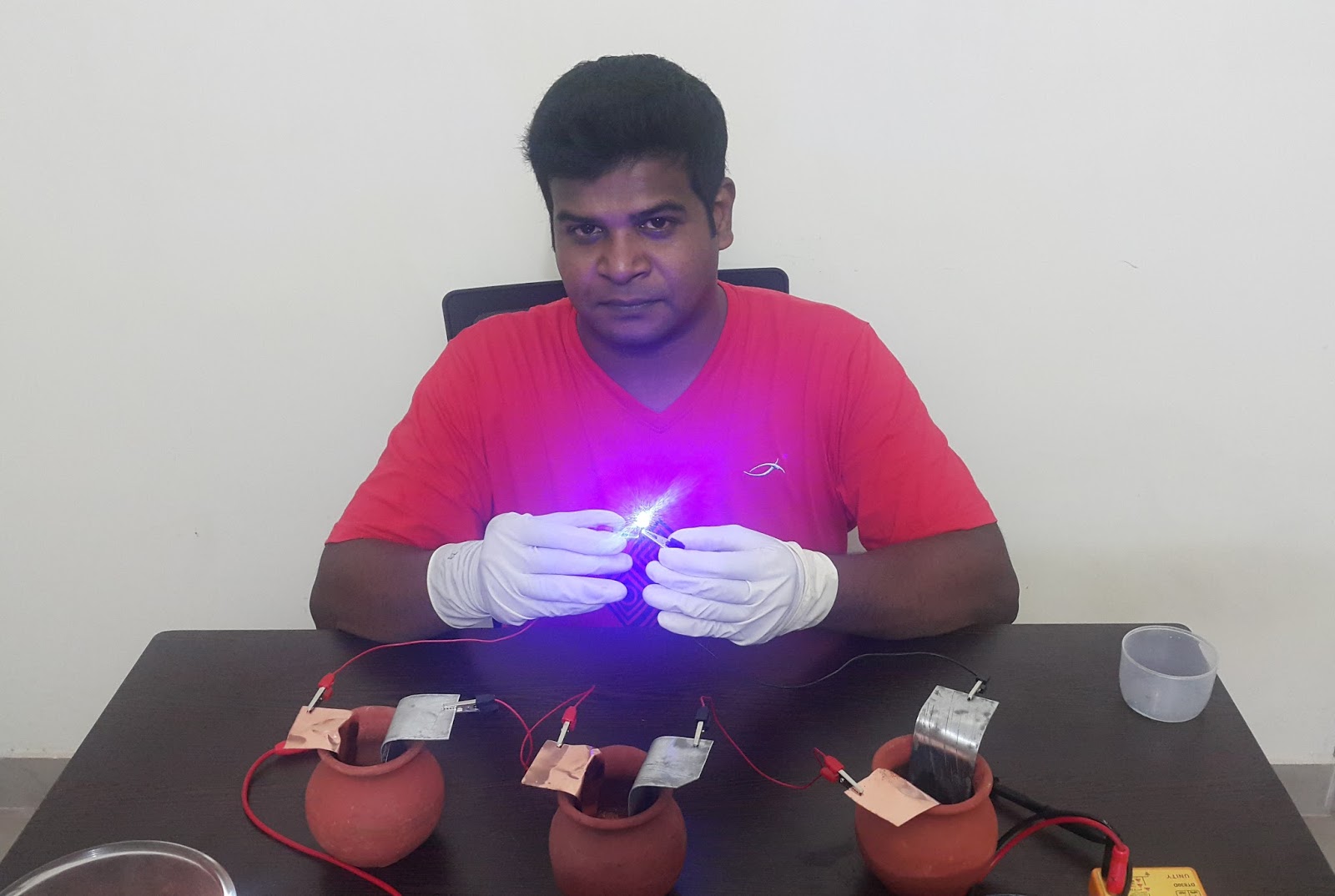
ancient text, Agastya says, use 100 containers and you can create a very
effective force. Here, I have just used 3 of
them in series and you can see that the voltage increases to 3 volts or xxx
volts. Now, if I connect a small Led bulb, you can see that it glows.
This is a very interesting point that the ancient text
mentions using the batteries for increasing the voltage. The natural question
is "WHY" was this used? Why did ancient people use multiple
containers to produce high voltage electricity?
Did they use it for lighting purposes, just like modern times? If so, is
there any evidence that electric bulbs were used in ancient times?
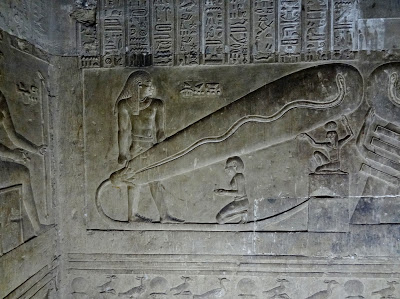
In the Dendera Temple of ancient Egypt, there are strange carvings
which show the usage of electric bulbs. These carvings were also created 4000 years ago, and you can see huge
electric bulbs with snake like filaments inside. What's even more interesting
is that there are wires coming out of these bulbs and going into a box. Did
this box, contain Agastya's battery of 100 cells, producing 100 volts to
illuminate these bulbs? If this is true, this might explain how ancient
structures like Giza Pyramid and Kailasa Temple were constructed in such a
short period of time. If we visit the Kailasa temple for example, the chambers
inside are so dark, that nothing is visible. There is no way to use mirrors or
metal sheets to reflect sunlight into these chamber for illumination. But,
there are spectacular, flawless carvings created inside these chambers.
Creating such brilliant carvings is impossible with flickering flames of
natural fire. How was it possible, without the use of steady electric light? If
we assume, that ancient people did use torches and used light from fire, for
creating this temple and carvings, there should be a lot of soot or carbon
deposited on the ceilings. But there is no trace of soot or carbon on the
ceilings at all. How do we explain the creation of these brilliant monuments?
Is it possible that the ancient people were using battery powered lights? How
else do we explain this ancient battery, mentioned thousands of years ago by
Agastya?
Agastya actually
explained many advanced technical devices in the same book. He talks about battery
powered vehicles. Today we have electric bikes which use just 24 volts. The
text mentions Electroplating which can be easily done with this set up. He
talks about splitting water into oxygen and hydrogen, and using this hydrogen
in balloons for traveling. We do hot air balloon rides today.
He also talks about the
concept of an electric motor. I have set up 5 of
these cells, and there is enough power to charge a cell
phone and we can even run a motor. This is
really fascinating because, once we realize that these type of gadgets were
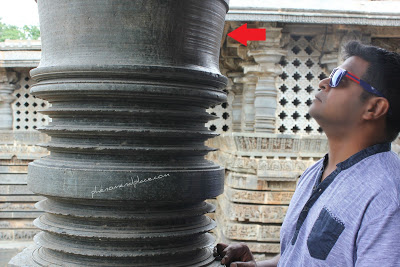
used in ancient times, we can understand how ancient temples like Hoysaleswaratemple were built. I've shown you the machine made pillars in this temple, and
even archeologists agree that these were made using lathe technology. If
Agastya's batteries and motors were used along with the gears and machining
tools carved on the Hoysaleswara temple, we can easily produce these machine
made pillars.
Now, why did Agastya
use earthen pots instead of other items? If he could use metals like copper and
zinc, he could have easily used these metals, wood or glass for the container. The
reason for using earthen pot is this. it cools what's inside, by a process
called evaporative cooling. The efficiency of the battery, dramatically changes
with its temperature, so the earthen pot will keep the battery at its optimal
temperature.
If these earthen pot
batteries were used in large numbers in ancient times, we should have found at
least a few of them. Believe it or not, archeologists have unearthed thousands
of these pots, in varying sizes all over India. The usual theory is that these
pots were used for burying dead people, but they have also excavated many, many
pots which don't contain human remains, but have metal plates instead. For example,
in the village of Chandayan, several pots were unearthed with copper plates
inside them. Archeologists estimate that these are also 4000 years old, which
matches the timeline of sage Agastya.
Are all of these
evidences just coincidences? The ancient battery that can light up a bulb - The electric bulbs carved in ancient Egypt -
Carvings in the dark chambers of Kailasa temple, with absolutely no natural
light - Today's motors running using just 5 cells? The machine made pillars of
Hoysaleswara temple - Thousands of excavated earthen pots with copper and metal
plates. Are all these evidences mere coincidences or do they prove that ancient
civilizations used advanced technology? Please let me know your thoughts in the
comments section.
The ancient iron pillar of Indiahas many baffling features which have not been explained till date. One of the strangest features is that it has not rusted for more than a thousand years, although we can see some rusting in the recent years. Archeologists confirm that this was created at least 1600 years ago, but it could be much older than that. An iron pillar made such a long time ago should have rusted and completely disintegrated. How was such a pillar made, 1600 years ago, at a time when Historians claim there was no advanced technology? Watch the video below or read on.
In 2002, scientists studied the iron pillar and realized that it has a strange way of reacting to the atmosphere. Normally, Iron reacts with moisture in the atmosphere or rain and produces Iron oxide, which is called Rust (Fe2O3).
This rust is very powerful, it will deteriorate the iron, and eventually destroy the entire structure. For example, if you look at this Nandu bridge in China which is less than 80 years old, it has been completely taken over by rust, making the bridge unusable. But the iron pillar does something very strange. When it comes in contact with moisture or rain, it produces a strange material called Misawite, which has not been seen anywhere before. This material actually forms a protective coating over the iron pillar and shields it from damage, and also increases its magnetic property.
Now, why does the iron pillar create Misawite instead of Rust or Iron Oxide? What makes this Iron pillar produce such a strange compound that is not seen anywhere else? The iron pillar is actually made of 98% Iron, 1% Phosphorous and the remaining 1% is made of an ancient concoction called Vajra-sanghata. This concoction is clearly explained in ancient Indian texts. The Vajra-sanghata is created by mixing 8 parts of lead, 2 parts of bell metal and 2 parts of calx of brass. So, if you look at the total composition of the iron pillar, it is made of a complex alloy, created in ancient times. Instead of rusting which is Iron Oxide, the phosphorous and Vajra-sanghata make water vapor which is H2O, to convert into Misawite, a compound of Iron, Oxygen and Hydrogen.
Fe + H2O = y-FeOOH (Misawite)
This layer actually protects the pillar from rusting. So, the pillar would accumulate this protective coating over the course of many centuries, making it even more stronger.Now remember I showed you Surang Tila, the temple that withstood a massive earthquake. The stones of this temple were also bound by ancient binding materials, making it last forever. So, you can see that the ancient Indian technology was really advanced in creating structures that stand the test of time. The other intriguing question is this: Who created this pillar? Now, there is an ancient inscription in Sanskrit on this pillar, which only hints at who could have created this structure.
The inscription refers to a King called Chandra and mentions that his empire basically extended beyond all the borders of today's India. It also explicitly mentions that his empire covered the southern ocean of India, which refers to the Indian Ocean. All experts think this refers to the King Chandragupta Maurya who lived around 300 B.C.
The problem is, that even the most exaggerated versions agree that Chandragupta never reached the Indian ocean, his empire did not touch the southern tip of India. But experts don't know of any other King with the name of Chandra who ruled the entire Indian subcontinent. But there is another King described in ancient texts who is not being considered. He is none other than Rama, the hero of the Indian epic Ramayana. Rama was explicitly mentioned with the suffix Chandra in ancient texts and referred to as Rama'Chandra'. Rama did cross the Indian Ocean in the southernmost point to defeat the King of Srilanka.
But there is another startling evidence in the inscription. All experts agree that what you see below is the most accurate, literal translation of the Sanskrit inscription.
"He, as if wearied, has abandoned this world, and resorted in actual form to the other world - a place won by the merit of his deeds - (and although) he has departed, he remains on earth through (the memory of his) fame (kīrti)."
This inscription clearly mentions that the King who installed the iron pillar, left to another world in actual form, which means he left physically to another world. These words are completely ignored by modern day historians, because they argue that all ancient civilizations were primitive, and could not posses advanced technology like spacecraft.
But all Hindu texts repeatedly state that the Gods came down from the sky, and used advanced flying machines like Vimanas. The ancient text of Padma Purana explicitly says that Rama left the earth and reached another planet called Vishnulokha. Now, even though all evidences point in this direction, why don't historians consider Rama as the person who installed this pillar? Because according to historians, Rama is not a historical figure, he is a fictional character mentioned in mythology and not in history. If you look at the history of Indian history, today's history books formally began during the British occupation, and they blanketly claim that any king who existed in India before 600 B.C, were merely mythical figures. This is the reason why figures like Rama and Krishna do not appear in History books, even though these ancient texts are called Itihasa which literally means History. Of course, in History Channel I have repeatedly stated that ancient Hindu texts show the real history of India. The fact that this pillar is still standing is enough evidence, that ancient India had a very advanced technology.
We have looked at many questions about the Iron pillar like how was it built, who could have built it and so on. But the main question is this: Why was the Iron Pillar built and placed in this location? What is the reason for constructing it with such complicated materials?
Archeologists claim it is just a decorative flag post - This is total nonsense. In my videos I have shown you how every ancient Indian structure was created for a specific reason - the wheels in temples were created to show time, even the smallest carvings served a purpose. So the real question is, why was the Iron pillar made in such a fashion, that it won't rust, like all modern electrical equipment? Today, all electrical components are specifically manufactured to be non-corrosive, but why was such a structure needed in ancient times?
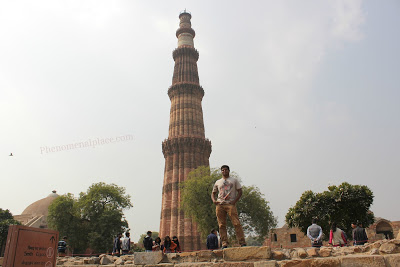
And most importantly how is it connected to the huge tower nearby known as Qutb Minar? Do you know that, if you exclude the height of modern day railings on the Qutb Minar, the Qutb Minar was built exactly 10 times taller than the Iron Pillar. The height of the Iron Pillar is 7.21 meters and the height of the Qutb Minar is 72.1 meters. Is this a coincidence that they were built to a 1:10 ratio? To understand the mystery, we have to examine ancient Indian texts to see if they used electricity. I hope you liked this post, and I appreciate your comments.
I have been researching this brilliant
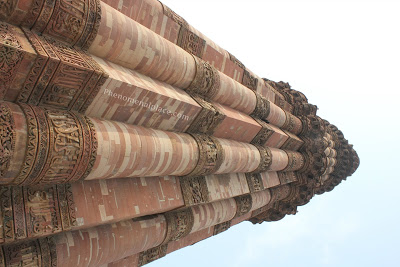
monument called Qutb Minar - historians say that this fantastic tower was built
by a Muslim ruler called Qutb al-Din Aibak also known as Qutb-ud-din, about 800
years ago. This site is recognized as a UNESCO world heritage site because it
full of Islamic structures like India's first mosque, the Qutb Minar and tombs
of famous Mughal kings. However, were these structures really built by Muslim
kings? Watch the video below or read on.
Now let's take a good look at
these structures, they are definitely Islamic structures. You can see the domes
on top, verses of Quran in Arabic carved on the walls, and typical Mughal
designs all over the structure. There should be absolutely no doubt in your mind
that these were built by Muslim rulers. But
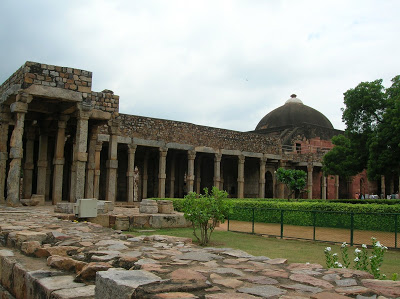
let's take a look at this unfinished structure nearby.
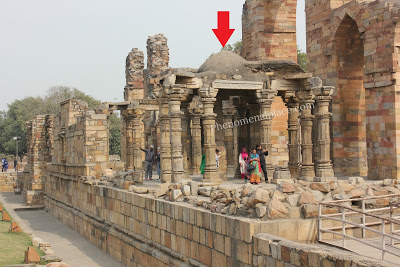
Here you can see how a dome has
been constructed on top, but is not finished. Below this dome, you can see that
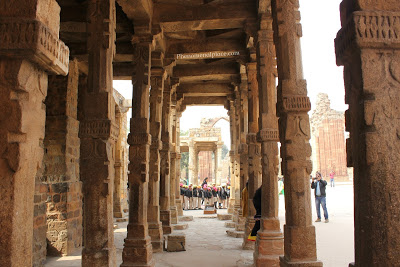
the pillars look very similar to the pillars of a Hindu temple. You can see
typical temple bells carved on these pillars. But let's go closer and see if we
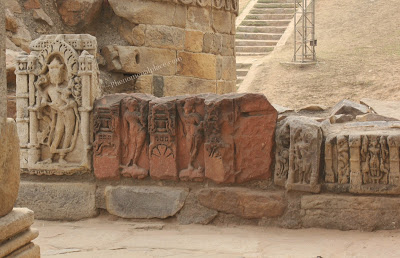
can find more evidence. Here we can see the defaced carving of Lord Ganesha,
the Elephant God who belongs to Hinduism. What is he doing in the Qutb Minar complex
built by Islamic rulers? In fact, we can see many, many carvings of Indian Gods that have been disfigured in this site.
On the top, you can even see the war scene from the
Hindu epic Ramayana. Remember, carvings of God, saints and human beings are
completely prohibited in Islam, so this
absolutely not an Islamic structure. You can even see the
Hindu religious altar called Balipeetam.
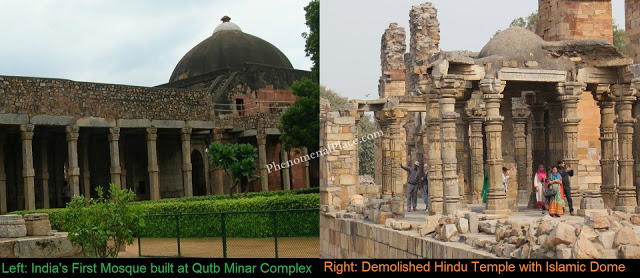
Now, let's go back and look at
the big picture. On the left, is the Jama Masjid which is hailed as India's
very first mosque built by Islamic rulers. On the right, is a Hindu temple, on
top of which an Islamic dome has been built.
The only difference between the
left and the right photographs is that the structure on the right was not
finished by Muslim Kings. Had the dome been finished, pillars been polished to
remove the carvings, the walls been covered with new plaster, and Islamic
designs and verses written on the walls, you would believe that this was also
built completely by Islamic rulers. Both these pictures were taken at the site
of Qutb Minar complex, they are only a few 100 feet apart.
Walking through various
structures of this complex, I realized that if you don't see the dome from the
outside, you would think this is a Hindu temple, because it is a Hindu temple
that's merely been converted for religious convenience. Islamic rulers did not even take
the time to demolish the ancient temples completely, and build new structures
with the same material. They made simple changes to the existing temples and renamed
them as Islamic structures. This is
evident when you see that the dome on top looks completely different from the
rest of the structure.
This wouldn't be the case if they reused the
materials from demolished temples. They simply constructed a new dome with a
different material on top of the existing Hindu temple, and defaced the walls
which had carvings of various gods. This is confirmed when you look at the ceiling
from the inside of the so-called mosque, it looks identical to the floral or
cymatic designs of ancient Hindu temples.
All these evidences, clearly
prove that the structures around this brilliant tower were in fact Hindu
monuments. But what about the tower itself? Was Qutb Minar, the most important
piece of this complex, built originally by Muslim Kings?
To understand this, we must understand
why the Qutb Minar was built. Why was this structure built to a stupendous
height of 240 feet? I mean, what is the purpose of this structure? The main
reason given by historians is that this was used as a Minaret, a place where a
man could stand on top and call the locals to come to the mosque for prayer. But
there are many problems with this theory. Why did the Minaret get all the
beautiful decorations, while the mosque which is the main building, is almost
in ruins? The entrance of Islamic Minaret's must face east, but the Qutb
Minar's entrance faces north. If you climb to the top of the tower using the
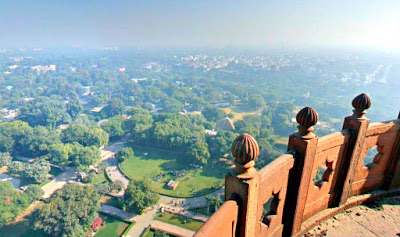
narrow spiral stairs, it will take you more than 45 minutes. How did anyone climb up and down 5 times a
day? Assuming you do this, the tower is so tall, that even if you shout at the
top of your lungs, nobody in the ground can hear you. The sound you make from
that height actually gets dissipated and dispersed, failing to reach the people
on the ground. You would need a mic, to be heard from such a height and
microphones didn't exist 800 years ago.
Historians also give another
reason: The Qutb Minar was built as a symbol to celebrate the victory and power
of King Qutb-ud-din. If establishing the fame and power of himself was the main
reason for building this tower, there
should be some inscription on the structure that bears his name. After all, Historians
say that this tower is the best achievement of him in his lifetime. However, Qutb-ud-din's
name is not inscribed anywhere on this tower, even though there are thousands
of other Arabic phrases inscribed on the walls. What's even more strange, his
name is clearly inscribed on the walls of the nearby mosque, and it explicitly
mentions that Qutb-ud-din did in fact establish the mosque. If Qutb-ud-din constructed Asia's tallest
stone structure at that time, and built it as a symbol of his power, why did he
not have his name carved on it?
Other flimsy reasons like this
was built as a watch tower are nonsense because Qutb-ud-din never built a fort
anywhere in this area, in fact he lived in Lahore which is more than 250 miles
away. Not to mention that watch towers don't have to be superbly decorated and
covered with the verses of Quran. In fact, most of the tourists who visit this
site, are completely unsatisfied with these explanations as to why the
Qutb-Minar was built. To this day, the question of "Why Qutb Minar was
built" is quite popular on Google.
The other baffling question is this: How was Qutb-ud-din able to build such a
grand tower? All historians agree that he ruled this place for just 4 years. How
did Qutb-ud-din, who couldn't even build these smaller structures, and merely
dressed them up as Islamic structures, manage to build this breathtaking
monument within just 4 years?
Imagine the time when Qutb-ud-din
first reached this place. This place was totally filled with ancient Hindu
structures, the Qutb Minar is still completely surrounded at the base by these
demolished Hindu monuments. Did the ancient Hindu builders leave an empty space
of 50 feet diameter exactly in the center of the complex, so that Qutb-ud-din
can come centuries later, and conveniently build the Qutb Minar? What's more
interesting is that the term Qutb-Minar itself must have been coined in the
1800s, to attribute the tower to King Qutb-ud-din. Because the term Qutb-Minar
does not appear in any Historical document before the last 2 centuries, even
Muslim historians do not mention this term.
Also, many historians are
spinning theories that it took many centuries to build the tower, and different
levels were built by different kings. This is a joke, because this kind of
extremely tall structures need a deep foundation, otherwise the entire structure
will just crumble down. Think about this, if the first Mughal king only wanted
to build one level, he would have only created a shallow foundation. Another
king who decided to build the next two levels cannot just go back and deepen
the foundation. He must simply demolish this and start from scratch. This is
like saying the empire state building was initially built as a single storey
house, and eventually people just built multiple floors on top of the house.
These kind of structures must be planned and built from start to finish,
otherwise they will just collapse like a house of cards. All these evidences mean that this tower was built
as an integral part of the Hindu temple complex, constructed much before the
time of Muslim kings.
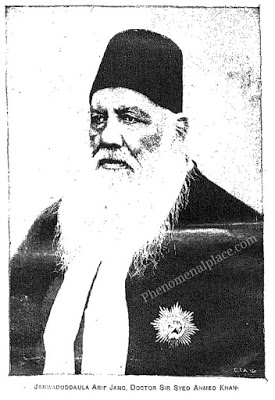
Ironically, the very first paper
published that Qutb Minar is a Hindu monument was put forward by a Muslim
archeologist, by the name of Syed Ahmed Khan in 1852. In his paper Āsār us-ṣanāddīd,
he states many reasons as to why this is a Hindu structure. When we casually
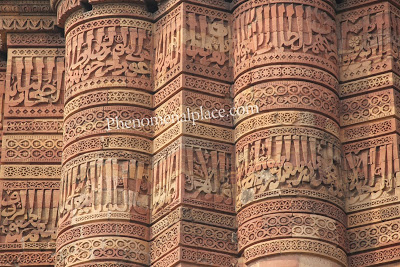
look at Qutb Minar, it does look like a Muslim monument because it is covered
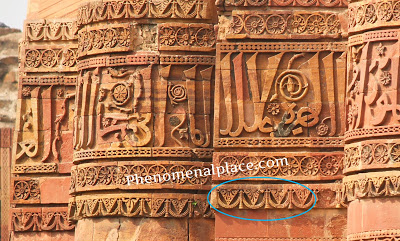
with verses of Quran in Arabic. However, if you observe the walls carefully,
you can see that Hindu carvings appear all over the place. Here, you can see
these patterns of bells and chains, which are Hindu symbols.
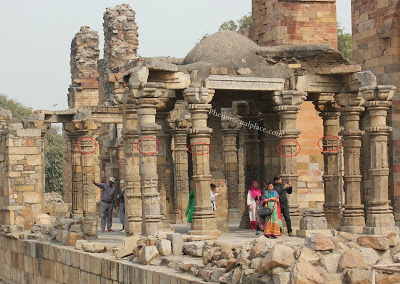
This is confirmed
when you can see the exact same design of bells and chains on the damaged Hindu
temples in the same complex. In the picture below, you can see it is all over the pillars.
This means that the tower was built around the
same time as the ancient Hindu temples, and not by the Islamic kings who
arrived much later in time.
Now, is it possible that the
Islamic kings simply liked this design, and asked the local builders to
reproduce them on the Qutb Minar? Bells are actually forbidden in Islam,
because Prophet Mohammed has said that "The bell is one of the musical
instruments of Satan." There is no way that any Muslim king would ask his
workers to carve bells on an Islamic monument. On the contrary, it is a well
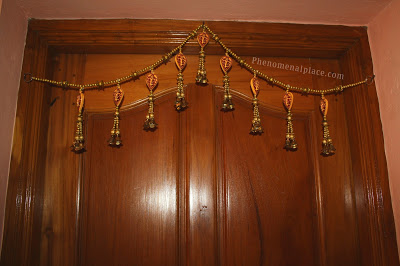
known fact that Hindus use bells in all their temples. In fact, these type of melodious
bells and chains are hung in many Hindu homes, even today, as a religious
symbol.
This proves that Qutb Minar was in fact a Hindu monument, that was
merely dressed up as an Islamic structure, just like how the other temples were
turned into Islamic buildings. The Arabic verses were simply added much later
in time, to make it look like a Muslim monument. Syed Ahmad Khan, who was an
expert on Arabic says that many of the Arabic verses on the tower have wrong
spelling and grammar, and make no sense. These verses were added in a hurried
and sloppy fashion, just like the disfiguring of the other temple's walls. The
entrance of Qutb Minar faces perfectly to the North, just like most ancient
Hindu temples.
The Muslim kings at that time, would
not have guessed that people today can examine the walls with binoculars and
zoom lenses. So they did not bother to disfigure smaller carvings. There are
patterns of lotus flowers carved all over the walls of the tower, which is a
sacred Hindu symbol.
Islamic invaders could not have used them, because lotus
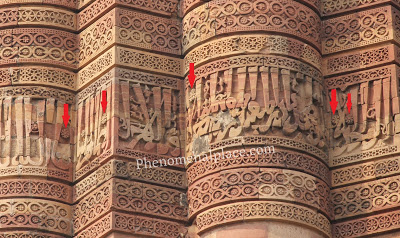
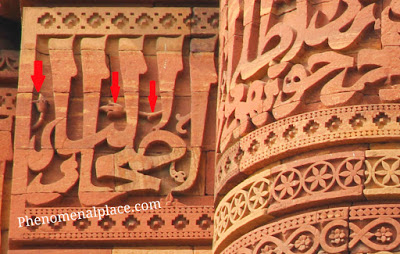
flowers simply do not grow, where they came from. These Large Arabic verses are
eye-catching, but if you observe closely, they have been added on top of Hindu
designs of lotus buds.
Not to mention that the Qutb Minar is made of the exact
same material that the ancient temples are made of. All these evidences prove that
the so called Qutb-Minar was in fact an ancient Hindu structure that existed
much before the arrival of Islam in India. However, this is not the end, but
just a beginning. What is the original name of this tower? Why was it built? To
understand its origin, we must look at another mysterious structure in the temple
complex - the Iron Pillar of India. I will explain this in my next post.