





Unlike most places in Singapore, Kranji War Memorial strikes a somber note, reminding us of thousands of brave men who died in World War II. Designed by Colin St Clair Oakes, this memorial has over 24,000 names inscribed on it. The bodies of these Allied servicemen were never found. Looking at the twelve columns of the Kranji War Memorial, you can see that they came from different countries like Australia, Canada, India, Malaya, the Netherlands and New Zealand. Encompassing the War Memorial is the Kranji War Cemetery, where over 4,400 brave men at least had the fortune of having a proper burial. There is an Anzac dawn service here on Anzac Day, observed on 25th April of every year for Australians and New Zealanders. Also important is the Remembrance Sunday or Veteran's day observed on the Sunday closest to 11th November. Patriotic Singaporeans and relatives of the dead pay tribute to the dead soldiers by observing silence here.

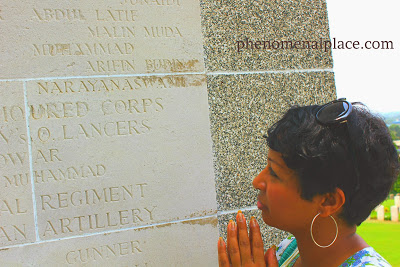 |
| Kranji War Memorial & Cemetery is visited by thousands who have lost their loved ones in War |
For Casualty Inquiries:
Address: The Common Wealth War Graves Commission,
2 Marlow Road, Maidenhead
Berkshire, SL6 7DX
England
Phone: +44 (0) 1628 507200
Fax: +44 (0) 1628 771208
Email: [email protected]
Opening Hours: 7 A.M to 6 P.M everyday
Entrance Fee: Free
Wheel Chair Accessibility: No
Car Parking: Available
History: On 8th December 1941, Japan made surprise air attacks on Singapore. In the next few weeks, there were sporadic aerial attacks targeting military airfields and the British naval base at Sembawang, Keppel and Tanjong Pagar dock areas. In January 1942, Lt. Gen. Percival, leader of the Allied Forces completed a defense plan. According to the plan, Singapore was divided into 3 broad fighting sectors: southern, northern and western - with a central area for controlling supplies of food, ammunition and fuel.
On 30th January 1942, British retreated across the Johor-Singapore causeway into Singapore. The next day, the causeway was destroyed and the Battle of Singapore began. On 7th February, the Japanese captured Pulau Ubin, an island off Changi. The first invasion was designed to divert attention away from the northwest coast where the main invasion took place. On 9th February, the Japanese captured Ama Keng Village and Tengah airfield, forcing the Allied Air Force to evacuate to Sumatra. The Japanese dominated the skies and their troops were able to land around Kranji, against the Australian positions.
| Map of Kranji War Memorial & Cemetery |
On 12th February, British forces selected the final defense perimeter encompassing areas in the central and southern region of Singapore. The Japanese pressed towards Singapore city on four fronts despite suffering heavy casualties. The next day, Japanese Commander Lt. Gen. Yamashita moved his headquarters to Ford factory near Bukit Timah. The Opium Hill (Bukit Chandu) was fiercely defended by Malays in an epic 48 hour battle while all the other defense lines collapsed. On 14th February, the Japanese captured the Alexandra hospital and massacred patients and medical personnel. On 15th February, the British officially surrendered to the Japanese at the Ford factory resulting in 130,000 Allied prisoners of war.
| The register at the entrance is used by visitors for commemorating the brave men and women |
| Kranji War Memorial has 12 walls with more than 24,000 names inscribed on it. |
| Kranji War Cemetery has over 4400 burials and is spread around the Memorial |
| The Cremation Memorial is dedicated to Indian soldiers whose mortal remains were committed to fire |
Singapore Unmaintainable Graves Memorial: This is found on the right side of the War Memorial. It was constructed to remember more than 250 soldiers who were killed in action in the Malaya region. These known graves found in and around Malaysia could not be well maintained, and were not allowed to move due to religious reasons.
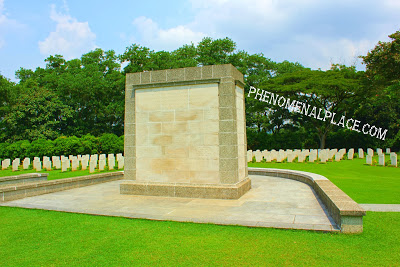 |
| The Hospital Memorial was erected to remember the soldiers and civilians who died in the hospital at Kranji |
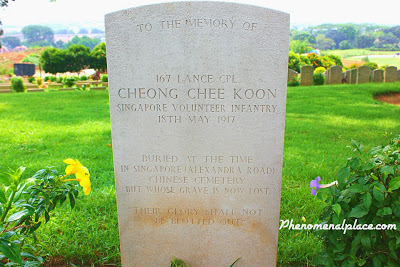 |
| The Chinese Memorial commemorates the Chinese soldiers who fought against the Japanese in Singapore |
British Garden: Adjoining the Chinese Memorial is the British Garden. You can find marked graves of British servicemen who died in action. The British played a key role in defending and developing Singapore until their eventual exit from the Malay region.
| The Gurkha Garden is dedicated to the Gurkha soldiers who gave their lives to defend Singapore |
| The Kranji Military Cemetery is used for burying the Non World War dead |
Kranji War Cemetery and Memorial is a must visit if you are a patriotic Singaporean, history buff or if you lost your loved ones in war. Australian and British people, most of them relatives of the dead soldiers visit this place to pay their respects. While Arab street and Night Safari are definitely the most fun places in Singapore, Kranji War Memorial will touch your heart and bring tears to your eyes. It will always be a place to remember the bravery and dedication of the men and women who lost their lives during the biggest war ever.


1 comments:
I was at the Cemetery in June & was speaking to one of the guides there (laughingly called herself the Dragon Lady) about the history of the near-by hospital. From a book by Charles Huxtable-From The Somme to Singapore- who was a medical officer there during the Japanese occupation, there is a couple of pages in ref to this subject (page 156 & 161). It was called Woodlands Kranji Camp & was used for sick Indian POW's, at the 13& half mile stone on the Main Bukit Timah Rd. He mentions the hill beside the camp where the cemetery is situated. Interesting read, please pass on to the relative person if its of any interest, Ian Muckersie
Post a Comment