





Santa Catalina Monastery is an enormous 215,000 square feet convent that has been operated by nuns continuously for the past four centuries. It is a must see in Arequipa, especially if you are a history or a religion buff. Located in Arequipa Downtown, it gives a unique history of the City's religious aspect. Most of the walls, furniture and machines are original and have been maintained carefully for centuries, although some restoration work has been done. Since it is operated by nuns and not by pastors, it should technically been called a "Convent". However, the name Santa Catalina Monastery has stuck throughout Arequipa's history.
Entry Fee & Hours:
Regular Schedule: From 9:00 A.M to 5:00 P.M
High Season: From 8:00 A.M to 5:00 P.M
Tuesday to Thursday: From 8:00 A.M. to 8:00 P.M.
Tip: Be sure to call before you go, sometimes the monastery may be closed for religious ceremonies.
Email: [email protected]
Phone: 51-54-221213
Fax: 054-281335
Entrance Fee: 35 Peruvian Soles or 12 US Dollars
Guided Tour: After you enter, ask for a guide. you will most probably be able to hire one for about 10 Dollars.
History:
The monastery was founded by Doña María de Guzmán, a rich widow who put all of her fortune into this monastery. The monastery was officially opened in 1580, where Doña María de Guzmán was the first official inhabitant. The families had to pay a hefty dowry to get their daughter's admittance. However in a few years, a massive earthquake struck Arequipa, leaving the monastery in shambles, forcing the nuns to repair the building themselves as there was no money. The monastery was forced to let the nuns' families rebuild, who built lavish comfortable homes for their daughters. The families used this opportunity, to even employ maids to make their daughter's life easier. During the course of the over the next 400 years, the monastery has had umpteen number of changes, conflicts and struggles.
Architecture:
The design of the building is predominantly colonial, however the natives added their own flavor of building style. Sillar (porous volcanic rock), is the primary building material used.The buildings are separated by streets, named after the cities of Spain. The streets are paved, and have channels on the sides for the rainy season. There are 81 individual houses in the monastery.
Monastery is divided into many segments. They are:
The Entrance: This is a very modest entrance for such a large building, with no paintings or carvings. On top, you will see a small relief of Sr. Catherine Of Siena, who helped in founding the monastery. All the blocks are made of volcanic rock (sillar) native to Peru. As you enter, you will see the ticket counter and the security guard.
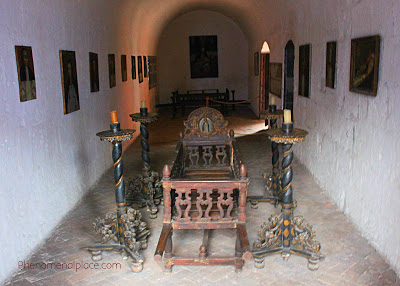 |
| Above: Mortuary room of Santa Catalina Monastery |
Cloister Of The Orange Trees: This is an open area adorned with orange trees, which symbolize eternal life. In the middle of the Orange Tree Cloister, there are three crosses which are used for religious ceremonies. Every Good Friday, the nuns re-enact the Passion Of Christ here. However, visitors are not allowed to see this event, and the convent is closed for visitors on that day.
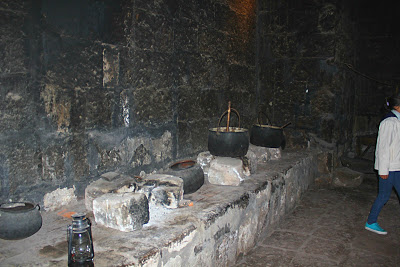 |
| Above: The kitchen still has the original stoves and utensils. |
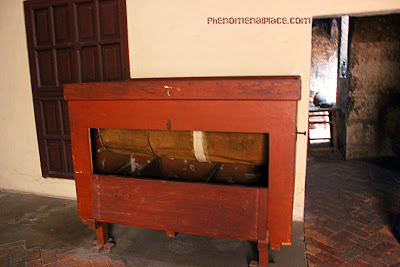 |
| Above: A Flour machine used by nuns to make holy bread |
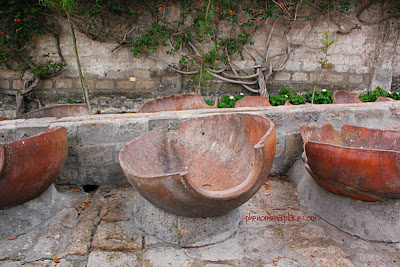 |
| Above: The laundry Area used half jars as washing tubs |
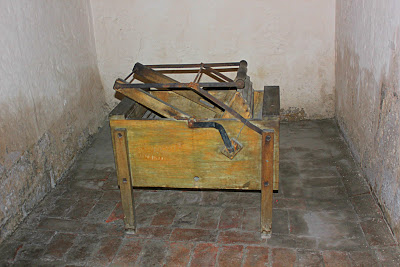 |
| Above: A laundry machine used by one of the rich nuns |
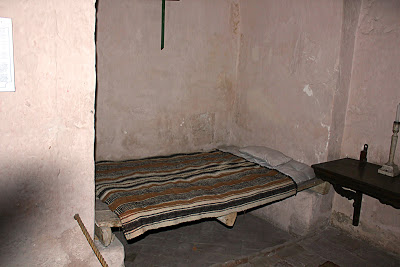 |
| Above: A bed used by nuns |
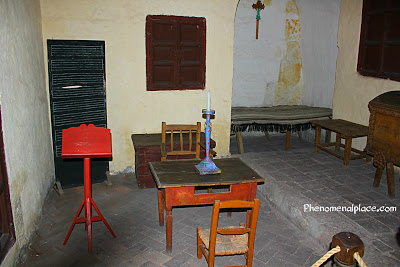 |
| Above: Furniture collection inside the house of a nun |
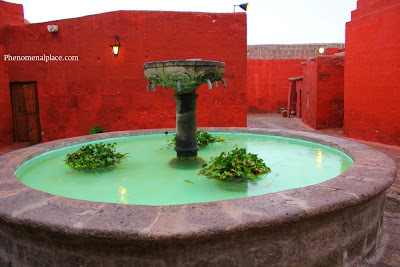 |
| Above: A fountain at the trading area of the nuns |
Zocodover Square: Named after the Zocodover market square in Toledo, Spain. The root of the word comes from Arabic 'souq ad-dawab ' meaning cattle market. Since the nuns never went out of the monastery, they created their own little trading market here. Every Sunday, the nuns gathered here, and traded items that they made or received from their families. It was also a place to show off the gifts they received from their families.
Belfry Tower: The tower has four bells on each street that are adjacent to the convent.It was built in 1748 by the city council of Arequipa.
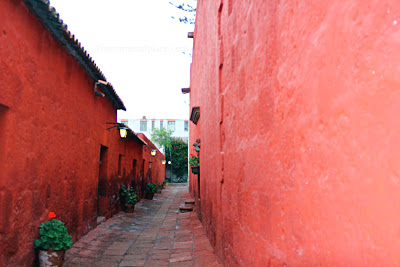 |
| Above: A street inside the Santa Catalina Monastery |
Think you have the patience of a nun? Watch the 25 minute tour inside Santa Catalina Convent:
- The nuns are still cloister nuns, meaning that they don't see outsiders. At the moment, the oldest nun in the monastery is 100 years old and a there are a total of 20 nuns.
- Walls are painted with natural pigments, a tradition that is still followed, and they are repainted every year after the rainy season. Be careful not to lean on walls, as the pigments do stick to your clothes.
- In olden days, the second child of a family was raised to become a priest or a nun. He / She was expected to pray for the family and their well being. Imagine being born as a second child in Arequipa in 1600s. What would you do?
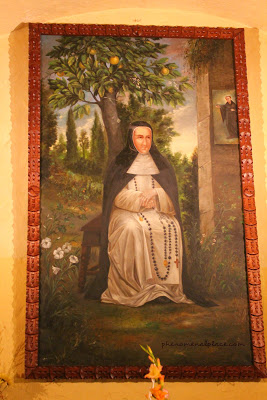 |
| Above: A portrait of Ana de los Angeles Montegudo |
- Ana de los Angeles Montegudo is the most famous nun who lived and died in the 1600s. She is said to have performed many miracles and is deified in the monastery.
- Initially ,the nuns enjoyed a luxurious life in the lavish homes built by their parents. However, the pope found out about this, and forbade them to continue this lifestyle. They were forced to sleep, eat and live as regular nuns thereafter.
- Unlike the Machu Picchu or the Nazca lines, this is one of the very few attractions which are not native to Peruvians. After the Spanish conquistadors took over Peru, they started building churches over existing Inca structures. Most, if not all Peruvians are now Christians and old Inca religious practices are almost forgotten.


3 comments:
Awesome article. I’m most definitely interest in this one. I am in reality happy with article quality and direction. This post is spot on in informative how some ideology applies to any script location. Thanks a lot for preservation huge stuff. I am extremely a good deal grateful used intended for this place. Thanks a lot for protection massive things.
After reading your post, you can see once again how ascetical the monks live, and in the past centuries it was even more difficult.
https://jaipurtempotraveller.com/rajasthan-tourism/
Post a Comment