
At the Taj Mahal, we can see a mysterious passage on the floor that goes directly
underground. Watch the video below or read on.
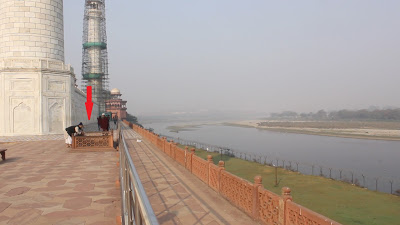
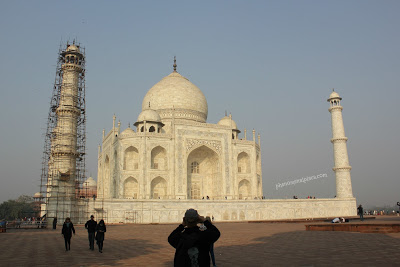
Now, if we take a closer look, it is not only locked with meshed metal
doors, but if you look inside the doors, it has been covered with wooden
boards. This not only means that you are not allowed to enter this passage, but
you are also not even allowed to see what's inside. Where is this underground
passage going?

This is located just outside the main structure of Taj Mahal,
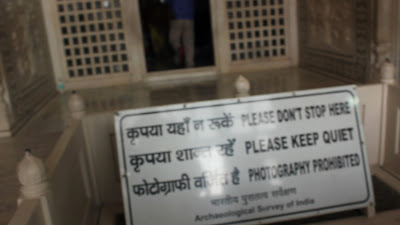
but if we walk inside the Taj Mahal, you can see yet another massive passage
that goes underground. This is also locked, but there is a sign that says don't
stop here or take pictures of this closed passage.
Why should a sealed passage,
not be photographed? Does Taj Mahal really have a secret basement
underneath? Authorities reluctantly
accept that Taj Mahal does have an underground area and they say that there is
a chamber which contains the tombs of King Shah Jahan and his wife Mumtaz. But at
ground level, we can also see two more tombs which are also the tombs of the
same King and Queen. Why would any dead person need two tombs, one at ground
level and other in the underground? They say that the underground chamber and tombs
are also made of white marble, just like the rest of the Taj Mahal, which is
entirely made of white marble. But is the Taj Mahal, made completely out of
white marble?
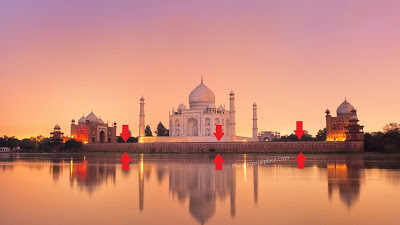
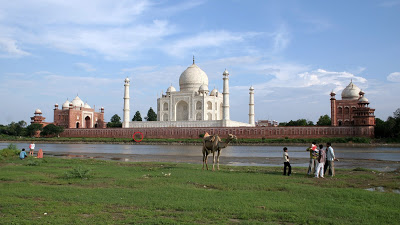
To understand the truth, let's
go to a side where visitors never go. We have to go into the nearby river, and
then observe what's going on. You can see that it has a huge base which is not
made of white marble, but is made of red sandstone. In fact all the structures
surrounding the Taj Mahal are made of red sandstone. This is best visible from
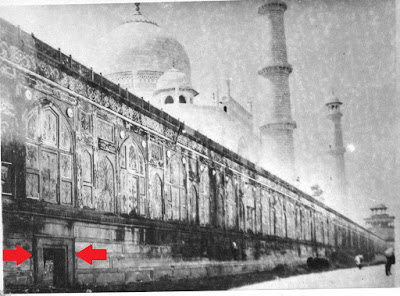
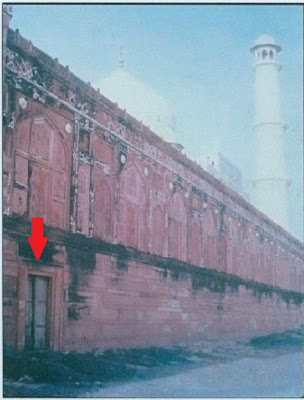
the river side. Remember the underground passage which was sealed off in plain
sight? This is also located on the river side - The passage is clearly made of
red sandstone, but look at the material on the floor, this is also red
sandstone. On the river side, there is something very interesting hiding in
plain sight - Did you notice this strange rectangle on the basement?
This is
one of the entrances that directly leads into the underground zone of Taj Mahal.
How do we know this?
Because an
American Architect by the name of Marvin Mills took clear pictures of this in
1974, and it had wooden doors, but was locked, so he couldn't see what was
inside.
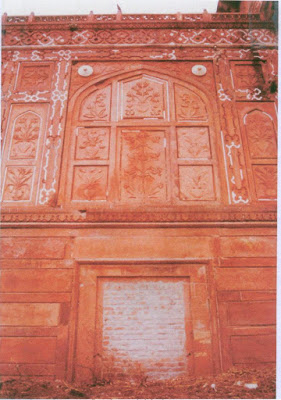
He took a small piece of wood from the door and sent it for radio
carbon dating and the result showed that the wood pre-dates Taj Mahal by at
least 250 years. Immediately after this information hit the newspapers,
authorities removed the wooden door and sealed it off with bricks and plaster,
which is why it appears in a different color now.
Why is the government repeatedly sealing off
all the entrances leading to the underground zone of Taj Mahal? Authorities have come up with a
rather strange explanation. According to them, the basement contains mummified
bodies of the King and Queen. If these bodies are exposed to the atmosphere,
they will get contaminated. They say this is why all the entrances to the
basement have been completely sealed off, to keep the basement airtight. This
is really strange because the floor of the Taj Mahal is full of ventilation
shafts which directly go underground. If you look through, they are so deep,
that it just becomes dark. If authorities are really preventing the exposure of
the mummies, which are already sealed inside marble tombs, why did they leave
these vents open? Why do they have to close only the bigger holes, through
which human beings can enter?
It's easy to understand that authorities don't
care about the air going in, but just don't want human beings to enter the
underground zone. If the basement of Taj Mahal merely contains the tombs of the
King and Queen, why do we see multiple passages to access the same chamber? And
why does the carbon dating evidence on the wooden door show that it was created
centuries before the Taj Mahal?
Is it possible that the basement
and the rest of the structures around the Taj Mahal were built centuries before
King Shah Jahan? To understand this, we have to read the book called Padshahnama
written by the court historians of King Shah Jahan. This
book explains the King's decision to build Taj Mahal in memory of the Queen,
but the same book actually proves that the rest of the structures around it were
already in place.
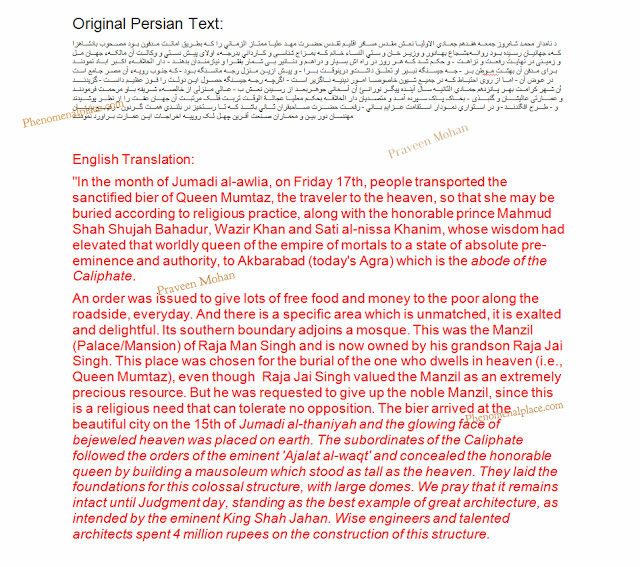
It explicitly mentions that King
Shah Jahan did not construct the Taj Mahal on a vacant land, but instead bought
the ancestral palace or mansion from another King called Jai Singh, and then
constructed the white marble structure in that place.
Some historians have tried to cover this fact by arguing that the word 'Manzil' means a tiny resting place, and not a mansion or palace. I have attached two pictures below which are Chattar Manzil in Lucknow and Errum Manzil in Telengana. This clearly validates that there was a palace at the site of Taj Mahal.
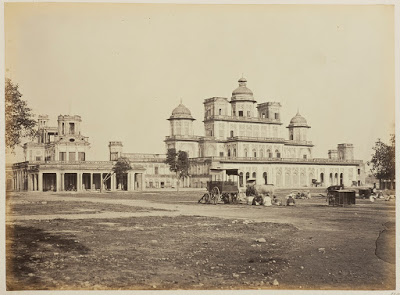 |
| Chattar Manzil at Lucknow |
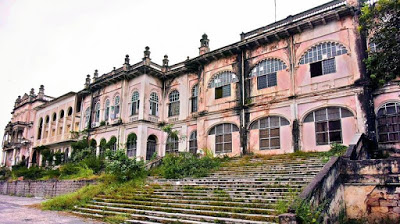 |
| Errum Manzil at Telengana
Okay, back to Taj Mahal. If King Shah Jahan wanted to build the Taj Mahal, he could have built it
anywhere in the same area, the entire area is still vacant. But
instead, he chose to buy an existing structure and built the Taj Mahal on it. Why did
he do this? Because constructing the Taj Mahal, the white marble
structure itself is a monumental project. In fact, King Shah Jahan
almost became bankrupt because of it. If
he chose to build the Taj Mahal on a vacant land, especially near the river,
the expenses and efforts would double because he would have to create a massive
foundation.
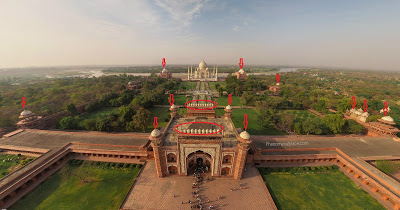 |
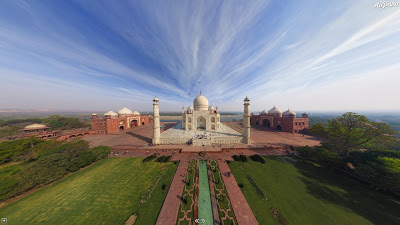
The aerial view, actually
confirms that the basement and the rest of the structures were built a long
time before the Taj Mahal.
All the ancient structures were built
completely out of Red Sandstone and bricks and resemble a fort.
These
were merely modified by King Shah Jahan by adding white marble domes on top.
This is a very clever architectural modification, because we cannot understand
this from the ground view at all.
Now, let's go back to the
underground zone of Taj Mahal. It is
clear that this zone predates Taj Mahal, but what's inside? Is it possible that the basement actually holds an
ancient secret, which the authorities do not want us to find out? Did
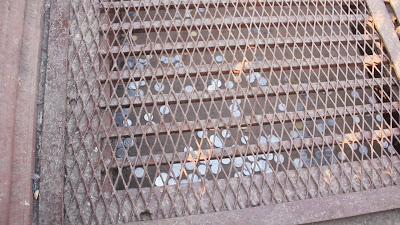
you notice the coins strewn on top of the sealed passage?
These are religious offerings by
locals, who believe that the underground structure is a temple of ancient Gods.
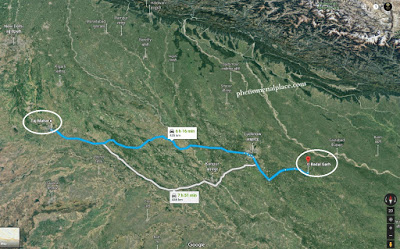
Locals refer to this temple as the Badalgarh
temple, and claim that it stretches underground for many, many miles.
So, I searched Google maps for
Badalgarh, and the closest Badalgarh is about 270 miles away. Can an ancient temple stretch underground for 270 miles?
This seems kind
of impossible, so I began hunting the nearby areas, and then I find something
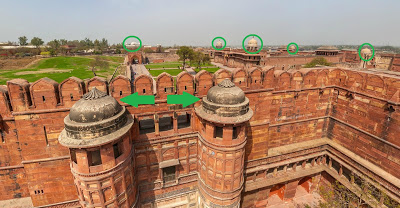
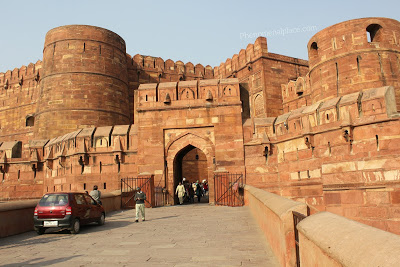
very interesting at this magnificent fort called the Agra fort. This is just 2 miles away from Taj Mahal. The original name
of Agra fort was Badalgarh, this is confirmed by historians and archeologists. But
again, we can see the same pattern - historians clearly state this structure
was merely modified by King Akbar, who is
the grandfather of King Shah Jahan. You can
see that while the main structures are made of red sandstone, the domes are all
made of different material.

This is a
breathtaking fort, but there is only one thing I am looking for: An underground
passage or at least a small tunnel.
And, not surprisingly: There is
a huge rectangular passage that goes straight underground, and has meshed
doors, but again you can see that it's locked. I
am told by the tour guide that this is in fact an old passage that goes
underground, and is not used any more but has been locked by authorities to
prevent anyone from falling in and having accidents.
Now, the problem is, it is
locked from the inside of the passage, this is why you don't see a key hole on
this side of the lock. This means that at least one person is inside this
passage, as we speak, there should be no doubt about this. Who is using these underground facilities and why? And
again, why do we see similar ventilation shafts going vertically down all over
the Agra fort as well?
And here, in plain sight, we can
see stairs that go down. As usual, this is also
locked, but at least we can see what's inside. This is not just a small tunnel,
but you can see a huge volume, they have
and there is something very interesting here: A dome shaped arch, very typical
of Mughal architecture. The first look into
this forbidden zone shows that these constructions
may not be ancient, they were in fact built by King Akbar or by his descendants.
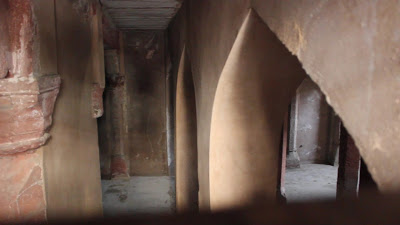
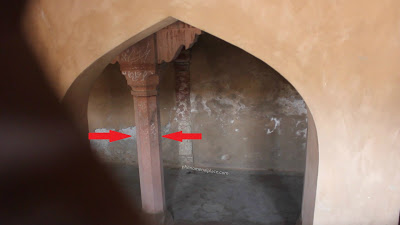
And then, I manage to peep through a hole.
Here we can see some solid
evidence that the underground structures belong to ancient times, the 8 faceted
pillar, with a square base which is found in almost all ancient Indian temples.
In fact, there is a name for this in ancient Indian
texts, it is called astakona skambha.

You can see these multi-faceted pillars in
almost any ancient temple in India, even the musical pillars of Hampi, are
multifaceted. Note that the pillar is also
made of red sandstone - the same material which makes up Taj Mahal's basement.
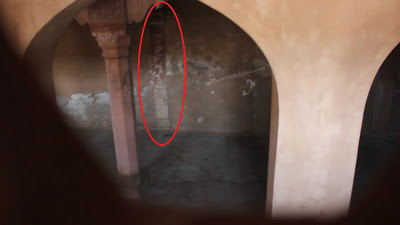
And these are newer brick walls built centuries
later, modifying the ancient underground structure.
And look at this area, a similar
octagonal pillar has been removed because it was interfering with the newer brick
construction. It is evident that king Akbar
or Shah Jahan constructed these newer walls , which is why they look fresh, but
the pillar looks much older. This proves that there is an
ancient underground structure that is being hidden from us, on top of which
both this fort and the Taj Mahal are built. Remember I said,
the distance between the Taj Mahal and Agra fort is about 2 miles.
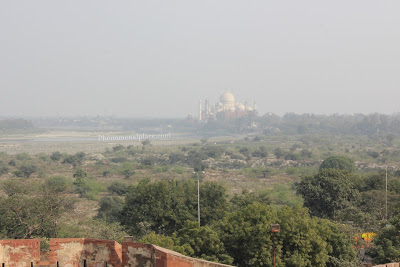
This is how
the Taj Mahal looks from the Agra fort. This
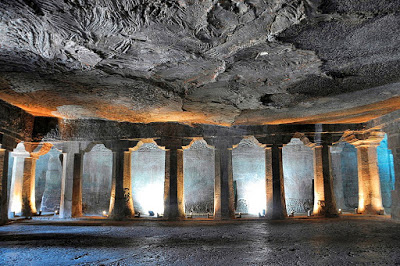
means a vast underground city stretches between them, much like the underground
city of Ellora caves.
So, what do you think? Why do we
have a sealed basement inside the Taj Mahal? What
is behind this entry way that goes underground? Why are the locals worshipping
this passage? What about the radio carbon
dating of the wooden door? Why did
authorities immediately cover it with bricks? How
do we explain these ventilation shafts? Why
is this door locked on the inside at the Agra Fort, which is miles away from
Taj Mahal? What about the ancient pillar
found inside? More importantly, why are all
these places locked? In my mind, there is no doubt, that there is a secret
underground facility of some sort, an ancient mystery kept hidden from us.
What about you? Please let me know your thoughts in
the comments section.