Nazca Lines of Peru - A sign of Alien Occupation?

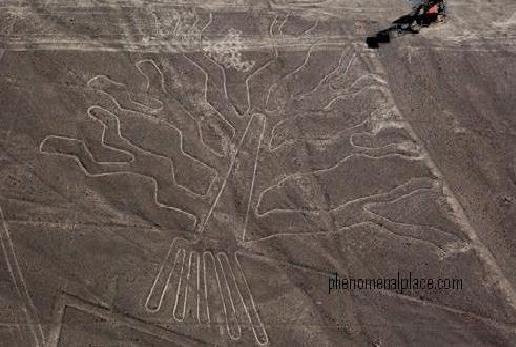
No matter how many places you go, Nazca lines (or Nasca) the weirdest and the most perplexing sight in the world. These figures were drawn by Nazca tribes around the time of the birth of Jesus Christ, and sometimes ranging over six hundred feet wide.

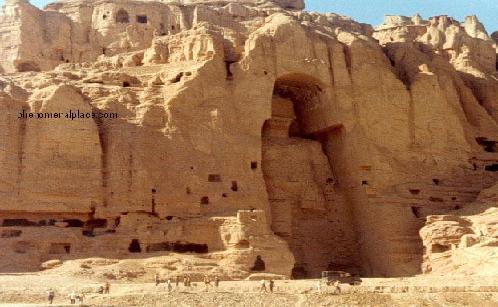
Bamiyan Buddhas of Afghanistan

When the Buddhas of Bamiyan were destroyed, the Taliban Muslims were shocked to find what was beneath the statues. Behind the statues were around 50 caves which was used (once upon a time) as a dwelling place for buddhist pilgrims.

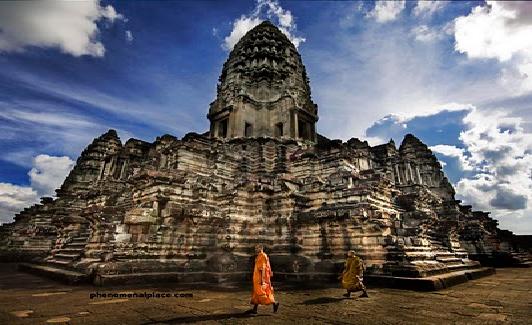
Angkor Wat of Cambodia

with more than 200 acres in land, the temple is carefully safeguarded by a moat. The sheer size of Angkor Wat will make you speechless. It was built in the honor of Vishnu, a hindu god. The design is based on Mount Meru, which is the mythical abode of Devas (Hindu Deities).

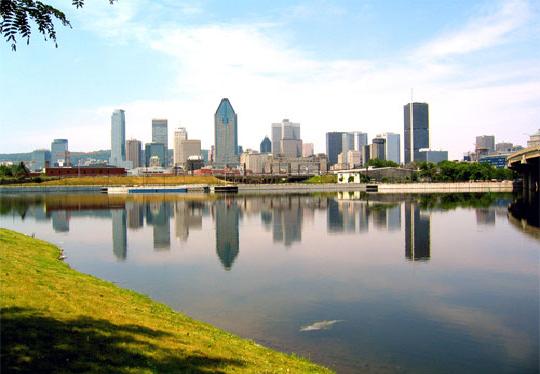
Montreal, Canada - A great place for vacation

Don't want to go to Europe to see french culture? Just go to Montreal! Amazing places, french culture, basilicas, museums and much more!!

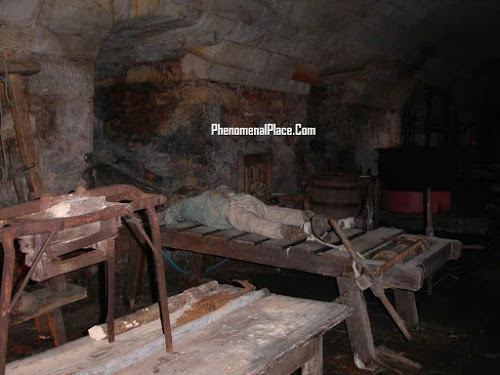
Chillingham Castle - A Scary Place

A torture chamber intact with 8 century old torture devices, A ghost sobbing behind the wall and much more..

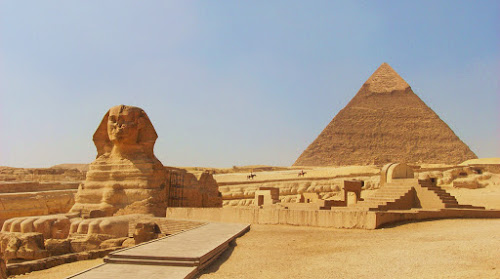
The Great Pyramid Of Giza

A Pyramid made of more than 2 million stones each weighing a ton, 4600 years ago. Unsolved mysteries of the Giza Pyramid, the interior virtual tour and fun facts! Click Now!

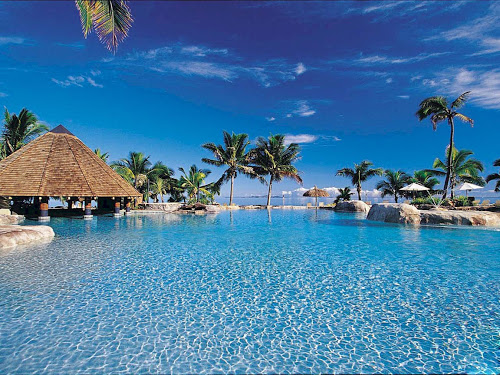
Fiji Islands - Pristine Beauty

A country of over 330 islands, over two thirds of them are uninhabited. The scenic beauty is unparalleled, and it is the best place to go whether you want to relax, or have fun round the clock!

Hacienda Sotuta de Peón - A journey into the past

Hacienda Sotuta de Peon is a live, operating plantation that has preserved the beautiful past of Yucatan. The moment you enter inside, you are surrounded by the 19th century houses, cenotes, mule ride, past machinery and the simple lifestyle of the Mayas. It is a unique experience and is a must see if you visit Merida, Mexico. The hospitality of the staff, the old Mayan tales and the great food at the restaurant make it an unforgettable event.


Address:

Calle 39 No. 286 x 32 y 34
Ampliación Dzodzil Norte
C.P. 97115
Mérida, Yucatán

Phone:  52 (999) 941 7190 ; 52 (999) 941 8639
 
 
Tour Rates:
Adults: 330  pesos
Children 4-12 years of age: 165 pesos
Children under 4 years of age: Free of charge
Adult Combo 700 pesos (Transportation, tour and lunch Included).
 
Transportation Rates:
Adults: 200 pesos
Children 4-12 years of age: 100 pesos
Children under 4 years of age: Free of charge

Days of operation: All days of the week; Both day and night tour packages available.

Tour Schedules: Morning tour begins at 10 A.M; Afternoon tour begins at 1 P.M .  The Night tour begins at 6 P.M.

Tour Duration: Three and half hours, excluding transportation. 

Parking: Available

Transportation routes & Timings:

You need to call ahead to book transportation.This service is offered from Hotels in Mérida only. Transportation services are given below:

Pick-up Time for 10:00 am tour:
North:
Starbucks Cafe Gran Plaza
Parkinglot Gran Plaza Mall, Colonia Montes de Ame
Time: 8:15 AM
 
Zona Hotelera:
Starbucks Cafe Paseo Montejo
Calle 56A No. 465, entre Avenida Colon y Calle 56 A, (Avenida Paseo Montejo), Colonia Centro
Time: 8:30 AM
 
Downtown
Modulo de información turística del Ayuntamiento de Mérida
Calle 62 por 61 y 63, Colonia Centro
Time: 8:45 AM
 
Pick-up Time for 01:00 pm tour:
For the 13:00 pm Tour: 12:00pm Hotel Lobby (Minimum 4 people)
 
Time of Return:
For the 10:00 am Tour: 16:00pm Hotel Lobby
For the 13:00 pm Tour: 18:00 pm Hotel Lobby (Minimum 4 people)


The Tour:

The tour begins when you enter through the gates of the Hacienda, where you will be greeted by Mayan ladies. They take you to a waiting area where you will be seated with other tourists. The tour consists of many sections which are given below:
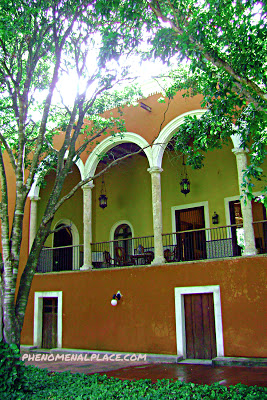
Above: The 'Main House' where the owners rarely stayed. They lived in Merida city.

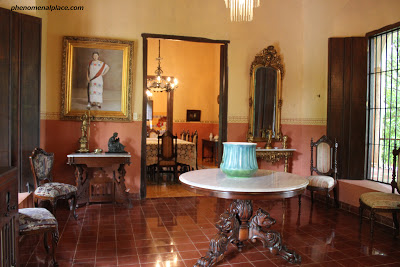
Visit to the Main House : Tour guide Rolando will greet you and take you into the "Main House" where the owners stayed from time to time. The house had been abandoned for many years and had to be restored. In this process, some of the original items had to be discarded. As you explore the house, Rolando explains about how the Mayas were exploited by the hacienda owners. The hacienda was like a small government, it had its own currency, church, hospital and even prisons. Money earned inside one hacienda cannot be spent in another, thus making the Mayans work in  a prison like environment.
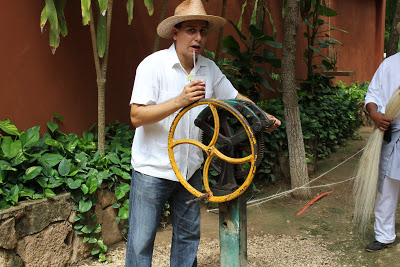
Above: Tour guide Rolando drinks Tamarindo just outside the Main House

After the visit to the main house is completed, you will be given a drink made of Tamarind juice and Hibiscus flowers. It is called  'Tamarindo'. It is especially great if it is a hot day.


Ancient Mayan Fiber processing technique: Here, Rolando explains how the Mayans extracted fiber from Sisal for centuries. They used a simple technique: Beat the sisal plant against rows of closely placed needles. The plant would gradually tear up into small fiber strands after beating repeatedly. You can do it too! Later, the Spanish masters thought it was too slow and implemented machinery to greatly speed up this process.


Sisal Processing Section:

This is where all the machinery comes in. There are 5 different buildings in which specific functions are performed. Sisal or henequen is processed from scratch to finish using these machineries. You can watch the full video here.
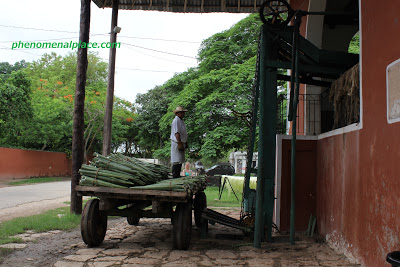
Above: Bundles of henequen leaves wait for processing. The truck wheels are designed for rails

1. Scrapper Machine: The leaves are cut from the fields and made into bundles and transported by mule driven carts to the machine house. Here, these bundles are fed into the scrapper machine that shreds them and make into wet fibrous material. The scrapper machine is over a century old and is still in good working condition. This machine can 'scrap' 300,000 leaves in 24 hours. In addition to its own leaves, Sotuta de Peon also processed henequen leaves from neighboring farmers.
 
2. Drying Area: The moist henequen fiber looks green and is not ready for processing yet. The shredded henequen leaves are moved to the drying area, the fibers are left under the sun to get dry.
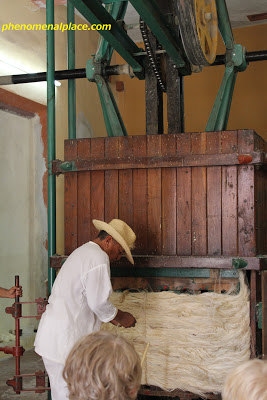
Above: The bummer press machine compresses fibers into a large bail

3. Bummer Press: Once the fiber is fully dry, it is moved to the 'Bummer Press' area. Bummer press is a tall rectangular machine which is capable of exerting very high pressure. The fiber is fed into this machine, and pressed to make a large bail. Each bail weighs about 400 pounds.  These bails of fiber are now ready for sale and are sold in the Merida market.
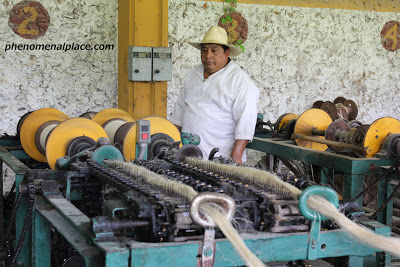
Above: Fibers are processed to make finished products at La Corcheria

4. Finished Goods Plant:  This area is also called Corcheria and is used for making end products such as ropes, bags, rugs etc. Some of the fiber from the drying area is directly transported here for making these items. There are a variety of machines in this area including spinning machines, weaving machines and spoolers.
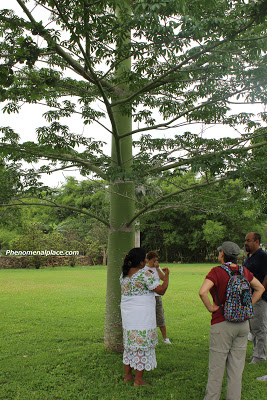
Above: The Mayan "Tree of Life" is still never cut down by Mayas

The Church and the Mayan Tree of life: After learning about how henequen was processed in the Hacienda, you will be led to a chapel. The chapel was more recently built and is modestly constructed. Just outside the Chapel is the "Mayan Tree of Life" , a Ceiba tree. The ancient Mayans believed that these trees were connections to the other worlds, the roots went into underworld and the top touched heaven. Even today, during harvesting timber, the Mayas respectfully leave Ceiba trees standing.
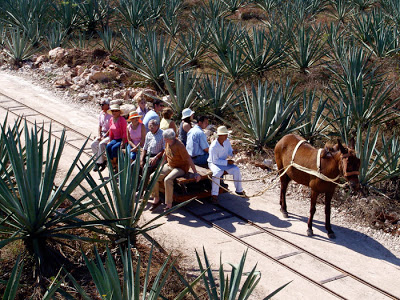
Above: Mules pull the platforms on rails for a nice ride around the hacienda

Truck Ride (Platform pulled by mules):

The hacienda has roads that have a basic rail system. Decauville rails have been laid all around Sotuta de Peon many years ago. The cart has wheels that fit on to the railroad and mules are used for transporting tourists and fiber. It is an open platform on which you sit and watch the landscape of the hacienda. Watch the mule ride video here. They also have a couple of ostriches which are beautiful to look at.


Above: Don Antonio explains his life in Hacienda Sotuta de Peon

Mayan House with tales by Don Antonio Ucan:

Next, you are taken into the "Mayan House" where you get to meet the 80 year old native Maya, Don Antonio Ucan. He explains his childhood days as a native in the Hacienda, how he used to cut crops and how simple the lifestyle was. The Mayan house is a one room hut with a hammock. Don Antonio joked around how the Mayas relaxed in the hammock, with one wife on either side. He talks on Maya and Rolando translates for you. Don Antonio Ucan has become quite an icon of Sotuta de Peon.
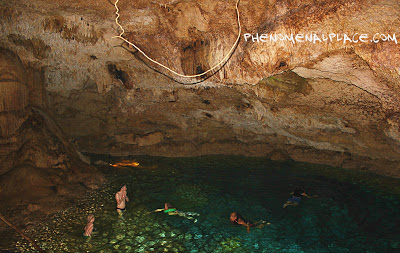


Above: Crystal clear freshwater in the cavern makes this an incredible cenote experience

Swim in Cenote:

Next, you are taken on Mule trucks to show you the Cenotes in Sotuta de Peon. We stop at the last cenote, which is Dzhul-Ha underground river. Life jackets, snorkels, swimming tubes and lifeguards are available. There is also a mobile bar to serve drinks and showers nearby. The cenote is incredibly fresh, with crystal clear water.  Swimming in the natural caverns is really quite an experience!
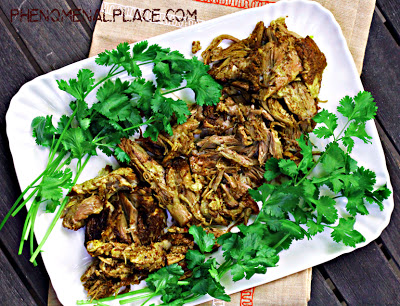
Above: Yucatan food served at La Palapa restaurant, Sotuta de Peon

Meal at La Palapa: Palapa means an open restaurant thatched with palm leaves. Yucatecan cuisine is very different from the standard mexican food. The restaurant has a buffet if they have enough number of tourists. If not, you can order from the menu. The menu includes Steak, seafood, rice, tortillas, tacos and beverages. Alcohol is served for a few extra bucks. The food here is really good and they serve a hybrid of Yucatecan-Mexican cuisine.

The meal is the end of the tour, and you can drive back or use their transportation to go back to your hotel.


Other services provided by Sotuta de Peon:
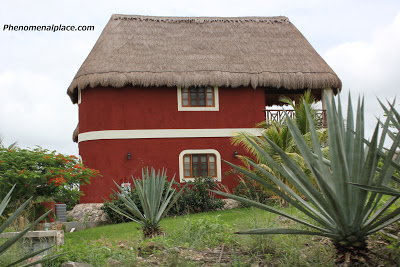
Above: The Hacienda Viva Village Resorts are private, lavishly furnished lodging places

Hotels (village resorts):

They have plenty of accommodations available for you to stay, as the hotels have only been recently built. They are built as individual huts, but furnished with everything you need. Some include private outdoor swimming pools which are temperature controlled. They are called 'Village Resorts' and can cost you US $ 250 - $ 330 per night.

Weddings: If you fancy having your wedding (and your reception) in a colonial plantation, you should book here. They have professionals who can take care of everything including budgeting, booking, assistance, etc. In addition to weddings, Sotuta de Peon can also provide services like

  • Christenings
  • Incentives
  • Sweet Sixteen
  • Corporate
  • Conventions

     
  • Other interesting info:

    1. Hacienda is a plantation where they cultivate and process henequen. Sotuta de Peon is the name of the village. We drove the village and asked for "Sotuta de Peon" instead of Hacienda Sotuta de Peon and people told us we are standing there. If you are driving, ask for "hacienda" or "entrada de hacienda."

    2. This hacienda was founded in 1858 and was operated successfully for many decades. Towards the last 50 years, the new generation owners lost interested and abandoned the place.

    3. Shangri-la group bought Hacienda Sotuta de Peon 30 years ago and started the restoration of machinery, buildings and cleaning up the unkempt cenotes.
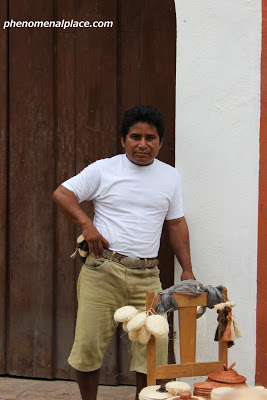
    Above: A Mayan worker poses magestically for our camera

    4. More than 80 Mayan families work in this Hacienda today. Hacienda Sotuta de Peon has become an icon of pride to the Mayan culture.

    5. After the fall of Mayapan, the last capital city of Mayas, they dissipated and mostly worked as farmers. Henequen or "Green Gold" was their important crop from 1500 A.D onwards.

    6. Uxmal ruins are located at an hour distance from here. Do check out the grandeur of Uxmal!

    Uxmal - The Ultimate Maya Experience

    Address: No exact address. It is located at 38 miles south of Merida city. You will see signboards on the highway that will lead you to the place.

    Hours: 8 A.M to 4 P.M every day of the year. There is a 1 hour light and sound show every night. This show starts at 7 P.M (November to March) and at 8 P.M (April to October).

    Entrance fee: 177 pesos for foreigners and 125 pesos for Mexicans. This fee also includes the light and sound show. 72 pesos for foreigners and 46 pesos for Mexicans.

    Remember: The narration during the Light & Sound show is in Spanish! So, you have to rent headphones (39 pesos) that give you the narration in English. These headphones are not very reliable, so double check them. Headphones are also available in French, Italian and German.
     

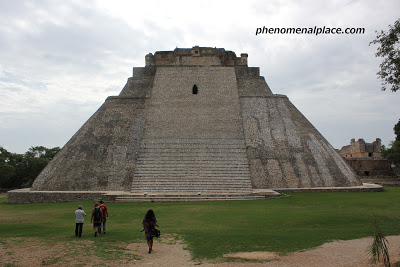
    Above: The Pyramid of the Magician aka Pyramid of the Dwarf
     
    Restrooms: Available. They are clean and well maintained.

    Shops & Restaurants: Available. There are many, just outside the entrance. You can buy souvenirs, Mayan handmade goods, snack or eat a decent sandwich.

    Lodging: A few hotels are available in walking distance to this site.

    Parking: Available, costs 20 pesos.

    Lockers: Available.

    Tour guides: It is recommended that you get one. The site is really big, if no one guides you, you will be walking here and there and get tired.

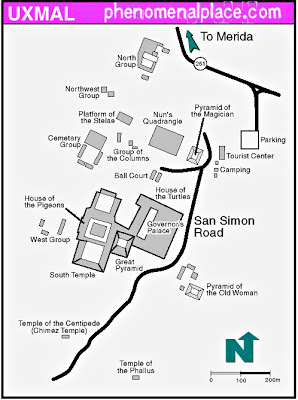
    A site map of Uxmal ruins that shows the significant structures


    History of Uxmal:

    Uxmal means 'Thrice built" possibly referring to the multiple layers built on the Magician's Pyramid. Some scholars also think that it comes from the Mayan word Ochmal which means "Future".  Uxmal was the capital city of the Puuc region constructed mostly from 800 - 950 A.D.
    However, the Maya Chronicles say that Uxmal was founded around 475 A.D -525 A.D by King Tutul Xiu. The vast construction and expanse of the site supports the idea of gradual construction over the centuries. The place was once a busy Mayan city where 15, 000 to 25,000 people lived. Mayans lived here until 1100 A.D under the Xiu Kings until the Toltecs invaded them. The Maya King was defeated and moved to Mayapan, which was the last capital of the Mayas.
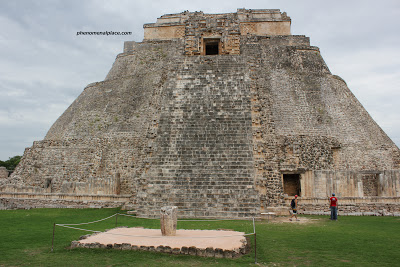
     Above: West side of the pyramid of the magician

    Magician's Pyramid or the Dwarf's Pyramid: This is the tallest structure in Uxmal, standing roughly 120 feet tall. The base is Oval shaped, as opposed to most Mayan buildings which have perpendicular corners. There are stairs angled at 60 degrees on both the eastern and the western sides. On the eastern side, there is an inner temple near the top in the middle of the stairs. On the western side, there are much less number of stairs and a large rectangular temple at the top. This is also called by many other names such as Adivino, pyramid of the soothsayer and so on.

    This pyramid consists of 5 temples, the 5th temple being the Magician's temple on top. Each temple appears to have been built at different times. At the top, the Magician's temple consists of three rooms and walls show lattice ornamentation. Visitors are not allowed to climb this pyramid anymore!

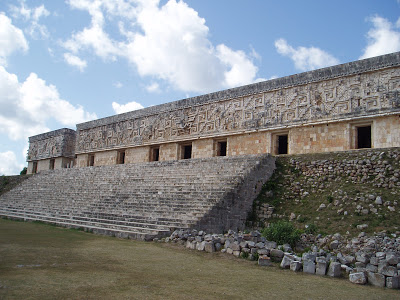
    Above: Governer's Palace, where the King of Uxmal lived

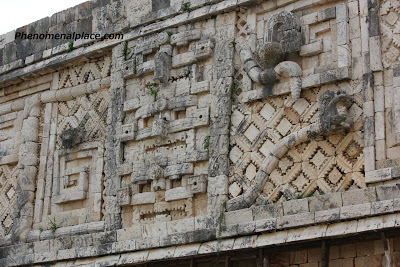
    Governor's Palace: This Palace sits on 5 acres and contains some excellent stone mosaic work.  The buildings are adorned with plenty of sculptures of snakes, jaguars and Mayan gods. The building itself is 322 feet long, 39 feet wide and 26 feet high. It is separated into three sections by tall transversal vaults. In the center, there is a throne with a seated sovereign, and is surrounded by intertwined serpents. This was dedicated to the Rain God Chaac, whose image appears more than 100 times on the walls.
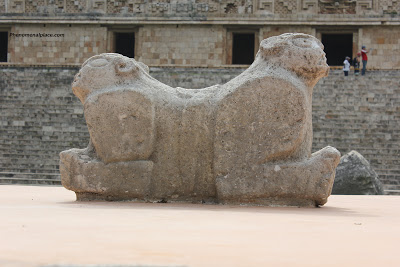
    A double headed Jaguar throne at Governer's Palace Entrance
     
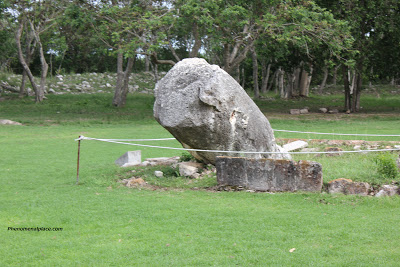
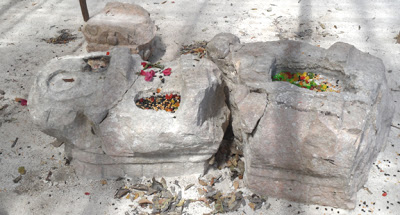
    On the entrance, you will see a double headed Jaguar throne, which are connected at the thorax. Nearby, there is a "Pillory Shrine" which is a large, tilted rock.
    Above: The pillory shrine which was used for punishing criminals

    This Pillory shrine is mentioned in Mayan mythology as a symbol of "Central Tree" aka "Axis Mundi". It was also used as a place for flogging criminals and dissidents.

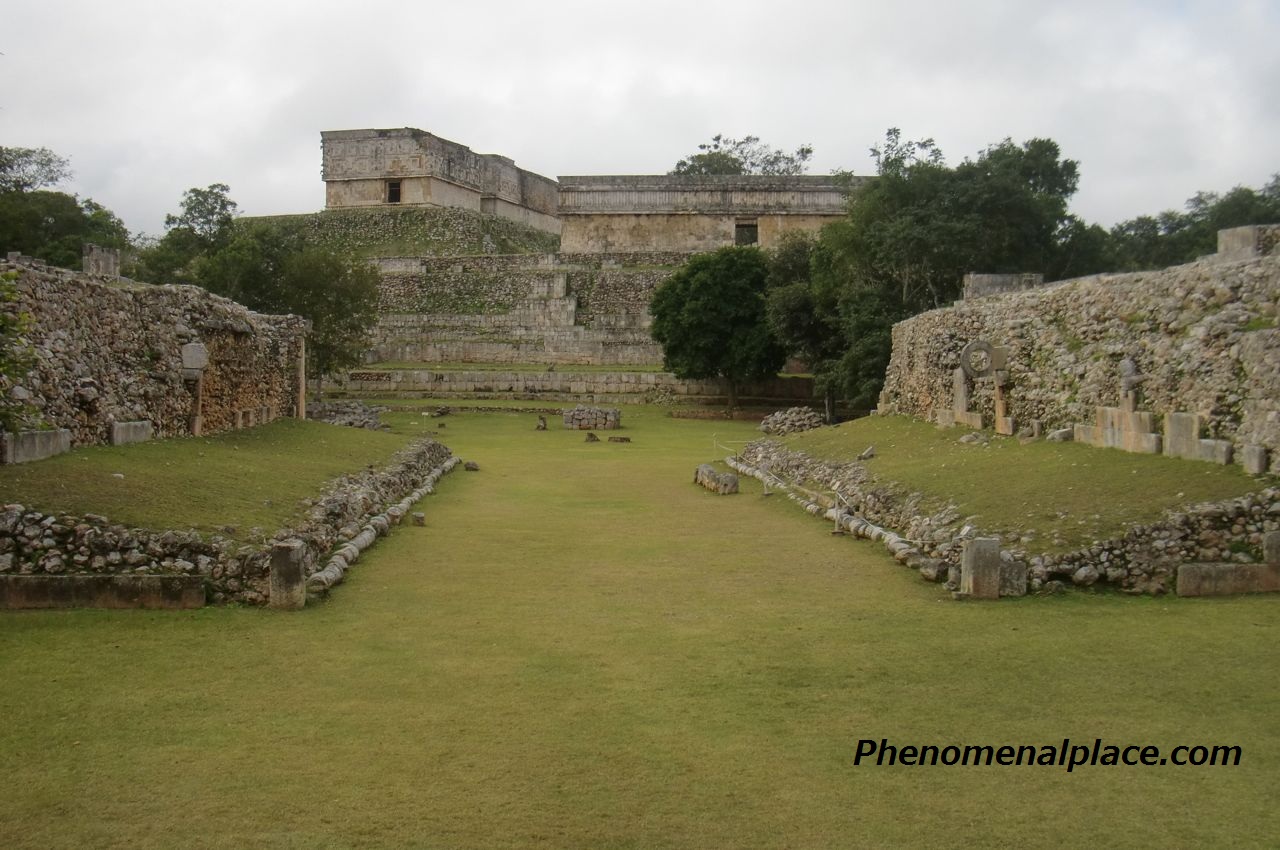
     Above: The Mayan Ball Court at Uxmal

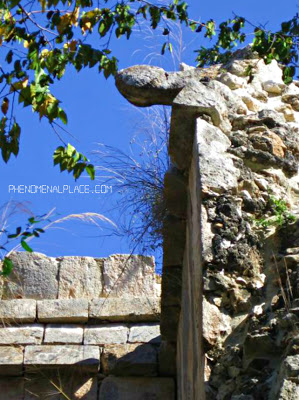
    Mayan Ball Court: This was a place Mayans played the game of Pok-a-Tok, which is explained briefly in the Anthropology Museum section.  The field is 110 feet long and 32 feet wide and was built by King Chan Chak Kaknal Ajaw in 901 A.D.
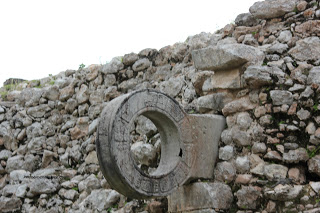
    Above: Mayan Ball Hoop adorned with hieroglyphs at Uxmal

    This ball court is has one side of the ball hoops intact, which also has Mayan hieroglyphs carved on it. It is commonly believed that the winning team captain beheaded himself which was considered an ultimate honor. However, there is no archaeological evidence to support this claim.
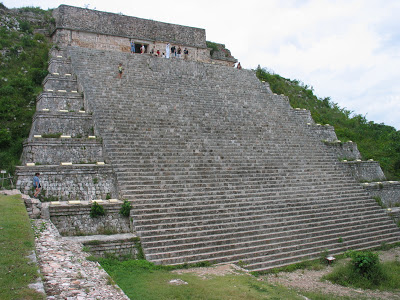
    Above: The grand pyramid at Uxmal, which has 72 steps denoting the power of Venus
     

    Grand Pyramid: This pyramid was originally 9 levels high and has been partially ruined due to natural and man made damages. A restoration project was carried out by the Mexican government which was abandoned in the middle. It is no Pyramid of Giza, but you can climb up this pyramid, and get a spectacular view of the Uxmal from the top. This pyramid was the religious center for Mayan ceremonies. At the top of the pyramid, there is a temple dedicated to Chaac, the rain god. The grand pyramid has 72 steps, which denotes an astronomical cycle. every 72 years the Solstice and Equinox Sun appeares to move backward through the constellations one degree.

    Above: A Penis shaped water spout that can "fertilize" soil during rain at Temple of the Phallus

    Temple of the phallus: Normally, you cannot access this temple. But if you insist, guides can take you into the woods and let you inside this Temple. The temple has many sculptures of Penis, and unlike the Lingams of India, the sculptures clearly depict human penis. The phallus is a symbol of the god of fertility Ixchel. You can observe many interesting features here. For example, there is a penis shaped water spout on the one side of this temple. When it rains, the water pours through the penis and "fertilizes" the soil! 
    Above: Mayans still perform rituals. Fresh flowers are offered at the House of the Old Woman.

    Pyramid of the Old Woman: Local anecdotes say it was built for the mother of the magician, which is unlikely. However, the old lady is still worshipped by local Mayas. You can find fresh flowers being placed on the altar here, everyday. It includes a pyramid and a few other structures.The smaller structures are in rubbles, filled with phallic sculptures. This must have been a temple dedicated to Ixhel, the Mayan god of fertility. The sculptures are similar to that in the Temple of Phallus. 

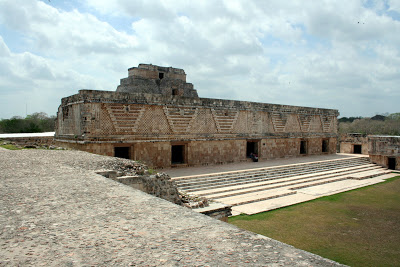
    Above: The Nunnery Quadrangle of Uxmal

    Nunnery Quadrangle: The nunnery quadrangle is four buildings: North, East, South and West buildings. This was built in 906 A.D and it is well documented in Maya literature. This building dedicated to the planet Venus and was used for astronomical and scientific purposes. The face of this building is decorated by 584 crosses, which is the number of days when Venus goes from "Morning Star" to "Evening Star" position. The name nunnery quadrangle was given by the Spanish conquerors as the small rooms, reminded them of the rooms of nuns.
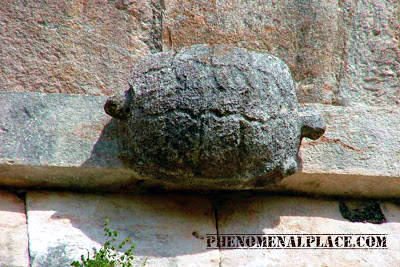
    Above: Sculptures at the "House of the Turtles" . Is this a double headed turtle?

    House of the Turtles: This is a simple structure adorned with sculptures of many turtles. Mayans had to depend on Rain heavily as most of the Yucatan peninsula has no rivers. In Mayan mythology, turtles were just like humans, they depended on rain for their survival. It was believed that turtles prayed to the rain god, along with human. Also, the Orion's belt was perceived as the Mayas as a "Cosmic turtle".
    Above: The pigeons quadrangle or dovecots of Uxmal

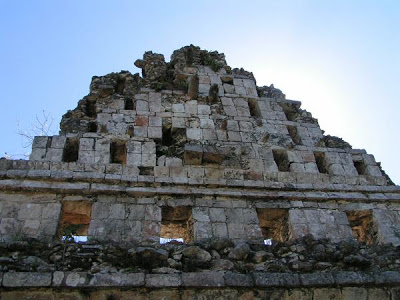
    Pigeons Quadrangle: This was a government complex similar to Nunnery Quadrangle. The exact purpose of this building is unknown. This building is completely ruined and may never be restored. Inside, there are many rooms which hint that people lived in them. Also, there are rectangular crests on the top of this building. Mayans built this to make Pigeons live in them.


    Other Interesting info about Uxmal:

    1. Human Sacrifices were performed at the top of the Magician's Pyramid.  In the book "Incidents of travel in the Yucatan" the author tells us how these sacrifices were done. The Mayan priest would carve the heart out of a living person with a flint knife. The heartless body, still moving would be tossed from the top of the pyramid. The moving body would roll through the stairs, spilling its remaining blood on the steps of the pyramid.
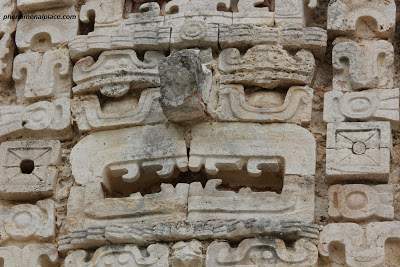
    Above:The Mayan rain god Chaac at Uxmal - Evil smile after defeating Queen Elizabeth II :)

    2. Mayan Rain God vs Queen Elizabeth II : in 1975, Queen Elizabeth II visited Uxmal for inaugurating the Light&Sound show.  The show is performed outdoors and it was a particularly hot day. As the show progressed, it reached the point where the Maya chantings to Rain God were sounded. A huge downpour of rain started, completely drenching the Queen and making her leave the place. The Mayan rain god Chaac had shown her who the real boss was. Even today, the local Mayans chuckle to this event and call it "Chaac vs Queen Elizabeth" event.

    3. Dwarf & The Old Lady: There are many different versions of the 'magician' who built the Magician's Pyramid. Here is one of them. Once upon a time, there was an old lady who had magical powers. However, she could not get pregnant and deeply regretted not having a baby. One day, she found a strange egg in the woods and brought it home. She checked it everyday to see if it hatched. A few days later, a human like creature hatched out of the egg. She was overjoyed and took it in as her own son. The creature started talking and walking immediately, but stopped growing after a year. Neighbors mocked the creature as a dwarf.

    Unable to hear the mockery, the dwarf ran to his mother crying. The lady told him that he was powerful than ordinary men. She asked him to go and challenge the King and he did the same. The king laughed at the dwarf for challenging him, but soon realized he could do everything that the King did. So, the King order him to build the tallest structure in Uxmal and the construction had to be done within one day. The dwarf went crying to his mother once again, but she made him sleep and chanted some mantras. When people woke up next morning, they found that the  Magician's pyramid had been completely built. It was the largest structure in Uxmal. The King was outraged and told the dwarf he would break bundles of heavy wood on the dwarf's head. If the dwarf survived, he would get his turn to break the wood on the King's head. The old lady placed an enchanted corn bread over the dwarf's head and told him to agree to the challenge. The dwarf survived the challenge, but it was now his turn to break bundles of wood over the King. The King's skull split into two halves and died. Thus, the dwarf became the King of Uxmal.
    Above: Intertwined serpents on the walls of Governor's Palace. You can see the head and tail.

    4. There are four smaller ruin sites around Uxmal: Sayil, Labna, Kabah and Xlapak. These are rarely visited by tourists, but you can ask a guide for the "Puuc route" ruins as they are collectively called.

    5. The entire site of Uxmal is yet to be fully excavated. Just walk around the woods and you will stumble on plenty of ruins hidden in the bushes. Our guide told us the Government has no money or interest in unearthing all the surrounding area. Plenty of findings to be made here.

    Tanque Verde Ranch - Tucson, Arizona

    Tanque Verde Ranch provides a truly amazing ranch experience. Your stay at this place will be totally relaxing and you can do plenty of activities like Horse riding lessons, Mountain Biking, Mountain riding, Fishing, Spa and more. You will be delighted with an authentic "Dude Ranch" experience and the best "Southern Hospitality".

    Address:
    14301 East Speedway Boulevard Tucson, AZ 85748
    Phone: 800-234-3833 ; (520) 296-6275
    http://tanqueverderanch.com/

    Room Rates: 120 to 700 US Dollars per night
    Package Rates: 265 to 695 US Dollars per night (Includes all activities including pickup from airport, food, lessons and everything)


    For a city slicker or a person who has never ridden a horse, it is quite an experience to ride horses here. All the horseback riding activities begin at the Wrangler's Roost. The wranglers are very friendly and teach you well to go from the basics to become a good rider. Remember to wear jeans or long pants, sun glasses and a hat secured with stampede string. You can purchase a stampede string for a dollar at the front desk.


    Above: Wrangler Cowgirls getting ready  to give loping lessons

    Horseback Riding Lessons:

    Basic Lesson:  The basic lessons are taught for the very beginners, who have never rode horses before. It is just a 30 minute session, where the wrangler makes you mount the horse, ride it gently and stop him.  If you take the breakfast ride or the mountain ride, you can safely skip this lesson.


    Above: People walking horses - A part of the basic lesson

    Horseman 'Fun'damental Lesson: A 90 minute session where you can walk and trot the horse, change directions and learns how to handle the reins.

    Intermediate Lesson: This is a 75 minute session where you progress into 'loping' where the horse starts to move faster than a trot, but not in full gallop.

    Lope Check: If you are familiar with horse riding, you can take the 'Lope Check' where they test your loping and trotting skills.

    Obstacle Course: An advanced lesson where you are expected to be a pretty good horseback rider.


    Above: Kids riding lessons are usually the kids' favorite activity here

    Kids Riding Lessons: The kids are taken in groups and taught how to ride horses. Each session is approximately 90 minutes. The kids do really enjoy this lesson.

    Horseback Riding Activities:


    Breakfast Ride: Starts at 7.45 A.M and you will ride on a horse to a beautiful hilltop where you have a nice breakfast. The view along the way is excellent, filled with tall cactus plants and other thorny trees. This ride is split into two groups: walking ride and loping ride. If you are a beginner, you should take the walking ride.


    Above: People eat breakfast at the mountain top

    Mountain Adventure Ride: This ride starts at 8 A.M and lasts until 12.30 P.M. As the name says, you will take an adventurous route on the mountain and explore the beauty of the sonoran desert.

    Team Penning:The riders are split up into two teams and you need to guide the calves into pens. Loping is not allowed and a great deal of team effort is required to do this activity. Calves run here and there and make this a difficult, but fun activity.

    Funkhana: FunKhana is a horse riding game where you have to maneuver the horse between barrels and cones set up in the Arena. Medals are given to the winners!

    Other activities:

    Rattle Snakes Show:

    The Rattle Snakes show is conducted on Sundays next to the Wrangler's Roost. You can see some live Rattlesnakes and the presenter explains about how their survival and their role in the
    environment.


    Fishing:

    You don't need any equipments or experience to go fishing in the Cochran lake in the ranch. Just walk over to the lake on Monday, Thursday or Saturday between 2.30 to 4.30. You can catch some blue gills for sure, and if you are lucky, you can even catch some bass or cat fish.


    Above: Bike or hike through the cactus filled Tanque Verde Ranch

    Biking & Hiking:

    Biking and hiking trips are popular. They give you all the gears you need and take you around the desert and the mountain. It is also fun because you get to spot many desert animals like rattle snakes, jack rabbits and bobcats.

    Other Games:

    There are a couple of tennis courts, a basketball court and a volleyball court. You can play pool in the Dog House Saloon. You can play foosball, Ping Pong and Bumper Pool in the Wrangler's Roost.

    Food:

    In an all inclusive package, you get all 3 meals for free and all activities are included.

    Breakfast 7.30 A.M - 9 A.M

    Lunch 12 P.M - 1.30 P.M

    Dinner 6 P.M - 8 P.M

    The food is excellent and will definitely meet your expectations.


    Kids Program: They have a dedicated kids program where you can leave your kids and they take care of them, almost all day. The kids do a variety of activities including horseback lessons, learning and playing other games.

    Above: The view from Tanque Verde Ranch

    Other Interesting details about Tanque Verde:

    1. Tanque Verde Means "Green Pool" or "Green Tank" noting a seasonal river close to the ranch.

    2. When you are hiking or biking in the mountain desert, you can spot several animals including jackrabbits, Javelinas, Bobcats, Mountain Lions.

    3. In the dining room, you can meet a lot of nice people if you choose to sit on the community table.

    4. Free Shuttle Service is available to and from the Tucson Airport.

    5. No TV in the rooms. They have tried to recreate an authentic ranch house type ambience. Sit outside the room for a great middle-of-the-desert experience.


    Above: Relax outside your room - It is right in the middle of the Sonoran Desert!

    6. Alcohol service could be made better. The Bar (Saloon) only opens at 5 P.M and closes anytime after 9 P.M. You can buy a cold beer ($6) anytime from the front desk, but you are better off buying a six pack for $16.

    7. Starlight movie nights screen "The Lone ranger" in the Saguaro Room.

    8. Check the brochures page that has all the information about Tanque Verde. You can't get them anywhere else online. Reading the brochures will help you decide what kind of activities and packages to choose.

    All about Mayapan Ruins - Yucatan, Mexico

    First thing first: The reason why we strongly recommend that you visit this place is because, you will be the only person exploring this place and you can do whatever you want including climbing up the pyramids. What they don't show you in those wonderful documentaries about Chichen Itza is how crowded that place is. Chichen Itza's architechure is far better than Mayapan but if you go to Chichen Itza, you are going to be constantly disturbed by peddlers, vendors and photographers who try to make some money off of you. Also, you can't touch the pyramid, can't take a tripod and so on.

    Address: No exact address. It is located 28 miles south east of Merida city. The closest town is Mani.
    Hours: 8 AM to 5 PM on all days.
    Entrance Fee: 35 Pesos.
    Remember: No nearby stores or vending machines! A restroom is available though.


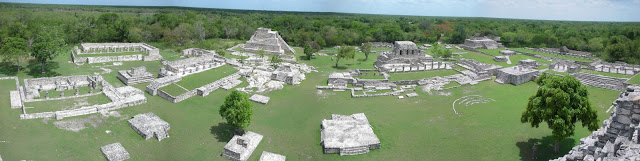
                                  Above: A panoramic view shot from the top of Mayapan pyramid

    History of Mayapan:

    Mayapan, means "The Flag or the Banner of the Mayas", and is the last great Maya capital.This Mayan city had an elliptical distribution and was surrounded by a stone wall with several entrances, covering over two and a half square miles with around 4000 structures. It is sometimes referred to as the "walled city". It is believed that this city once had a population of 15,000. Kukulkan II of Chichen Itza founded Mayapan between 1263 and 1283 AD. Mayapan continued to prosper until 1450 AD. In the mid-15th century, Mayapan was destroyed by war, later burnt and then abandoned.

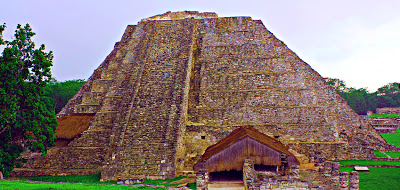
                                  Above: The castle of Kukulkan (Castillo de Kukulcan)
      

    Main Pyramid or The Kukulkan Castle:

    The main building or the pyramid is clearly inspired by the Chichen Itza. If you look at it from one side, you can actually pretend that it is the Chichen Itza pyramid. However, when you go around the pyramid, you can see that there are many flaws in the design. For example, the steps on one side of the pyramid are completely off the center line.You can climb up the main pyramid which is about 49 feet and get an amazing view of the layout of the Mayapan City.

    The main square was bordered by government, administrative and religious buildings, as well as the homes of the ruling class. These constructions were built over foundations of rows of columns, with temples and oratories, an altar at the back and benches along the sides.
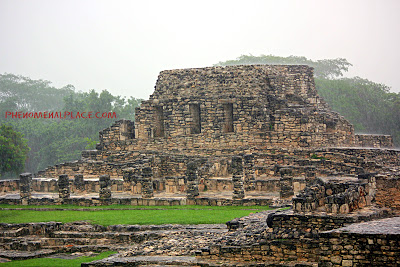
                            Above: The Temple of the painted niches holds Optical illusory style paintings

    Temple of the Painted Niches:

    You can walk into this temple through the ruined stairway. Once you are inside the temple, you can see 5 murals on the walls. The paintings are done in Trompe-l'œil style which depicts three dimensional objects on (2 dimensional) walls. These optical illusion style paintings must have been a splendid view for the Mayans who lived centuries ago.  These 5 niches are the symbolic entrances to the Temple. These paintings are excellent examples of the ingenuity of Mayan people.


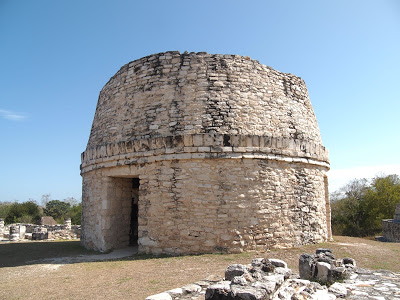
    Above: The Main Observatory of Mayapan 

    Observatories or Caracol:

    Also found are the cylindrical buildings known as "Observatories". The main observatory was used for astronomical purposes such as tracking the planet Venus. Scholars have also discovered carvings that denote the position of Venus on this building.

    You will find the ceremonial center in the west of the site with the most important structures like the noble class residences. You can observe the light phenomenon on this pyramid during the winter solstice on December 21st each year, just like in Chichen Itza.

    Above: The Stucco relief without the head where a human skull was found instead

    Decorations and Reliefs:

    You will find one special wall decorated with Mayan glyphs and a mascaron, showing a circular opening instead of the mouth and with an elephant-like trump on one side, which is the symbol of Chaac, the Mayan god of the rain.

    There are also stucco reliefs at the base of the Castillo de Kukulkán, which is the main pyramid. Here you can see carvings of complete Mayan figures, ant this one has an opening in the stone where the head should be. When the Mayapan ruins were discovered, they actually found a human skull in there.
    Above: The steps and columns of Mayapan ruins

    Other features of Mayapan:

    On the premises you will see many smaller pyramids like structures with altars, smaller round observatories, colonnades, broken statues, and a large residential zone with numerous low platforms, which were once home to regular maya people. There is also a Cenote which provided water to this city. There are lots of Cenotes in this area, and they have been providing water to the Mayans for many centuries.

    Above: The Church in Mani Town, where Mayan scriptures were burnt

    The town of Mani:

    The church and convent in Mani, Yucatan is the site of the infamous 1562 burning of the Mayan Codices and manuscripts by the Bishop Fray Diego de Landa. Like most Spanish colonial churches of Yucatan it was built by using the cut stones of Pre-Columbian Maya temples. The great bonfire Landa held turned to ashes almost all written records of the Maya. Only three codices are known to have survived. Landa proclaimed the books contained "nothing but the lies of the Devil" and he burned them to aid his mission, converting the Maya to Christianity.

    Mani has been continuously occupied for approximately 4,000 years. In the postclassic Mesoamerican era, it was home to the Tutal Xiu Maya dynasty, which moved their capital here from Uxmal in the 13th century. The Xiu were the dominant power in the western Yucatan after the fall of Mayapan in 1441.

    Virtual Tour of Mayapan Ruins (watch below):

    Anthropology and History Museum - Merida, Mexico

    If you are interested in learning about the Mayan Civilization, this is a great place to start. The Anthropology and History Museum also called "Museo Regional de Antropología" has the best collection of Mayan artifacts and showcases the extraordinary culture and technological advances of the Mayas.

    The address: 
    Palacio Canton, Paseo de Montejo at Calle 43
    Merida, Mexico
    Phone: +52 (999) 923-0557
    E-mail: palacio.canton@remove-this.inah.gob.mx
    URL: inah.gob.mx

    Entrance Fee: 41 pesos for foreigners. Free for Mexicans under 13 and over 60.
    Video Camera: 45 pesos.
    Open from 8 AM to 5 PM.
    Plenty of roadside parking spaces available.
    Remember: They are closed on Mondays!
    The museum itself has two levels. On the ground level, there is an extraordinary collection of Mayan artifacts . There are also some great educational tools, like posters explaining the mathematical system of Mayans. These items are arranged in chronological order, so you can see how the Mayans progressed from time to time. The upper level displays the recent history of Yucatan, starting from the Spanish conquest of Mexico.

    Let us see some highlights as there are just too many artifacts to include everything in this blog. You can check the full video at the bottom if you want to see the virtual tour (26 minutes).

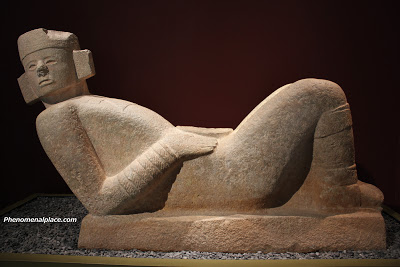
    Sculpture of Chac Mool:

    Chac Mool is a demi-god personality who is lying down, but his head is turned at right angle to his body. You can also see a circular plate carved on his belly, possibly for placing gifts or donations. This exquisite piece of sculpture wa carved between 800-900 A.D. Sadly, his original name remains unknown and he was named Chac Mool (meaning Red Claw in Mayan language) by the explorer August Le Plongeon.

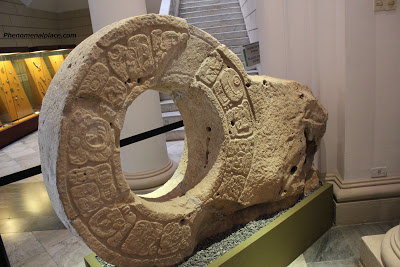
    Pok-a-Tok - The Ancient Mayan Ball Game:

    The Mayan Ball Hoop is big enough for us to slip through it. The ancient Mayans played ball games and yes, they vulcanized rubber way before us. The game is very similar to modern day Basketball, but you could only use your legs, hips and butt to play. It was common to have a ball court in the Mayan palatial complex. For example, Chichen Itza has the ball court as big as a football field.
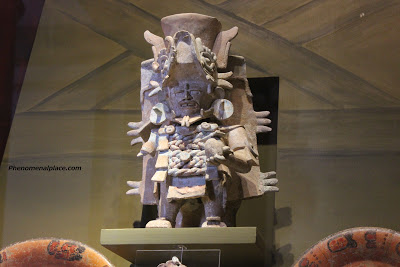
    The Mysteriously Astronaut-like Mayan Gods:

    The museum displays a wide variety of Mayan Gods and most of them look eerily similar to astronauts. Now wonder alien theorists think that they must have come from another planet. Below, you can see one of them, with an incredible head gear (popped up?) and adorned with gadgets. Don't forget to note his rugged boots! On a side note, it is interesting to see how the Mayans felt about gods.They believed that humans were the perfection of God's creation. Gods were disappointed with their creation of animals, birds and reptiles.

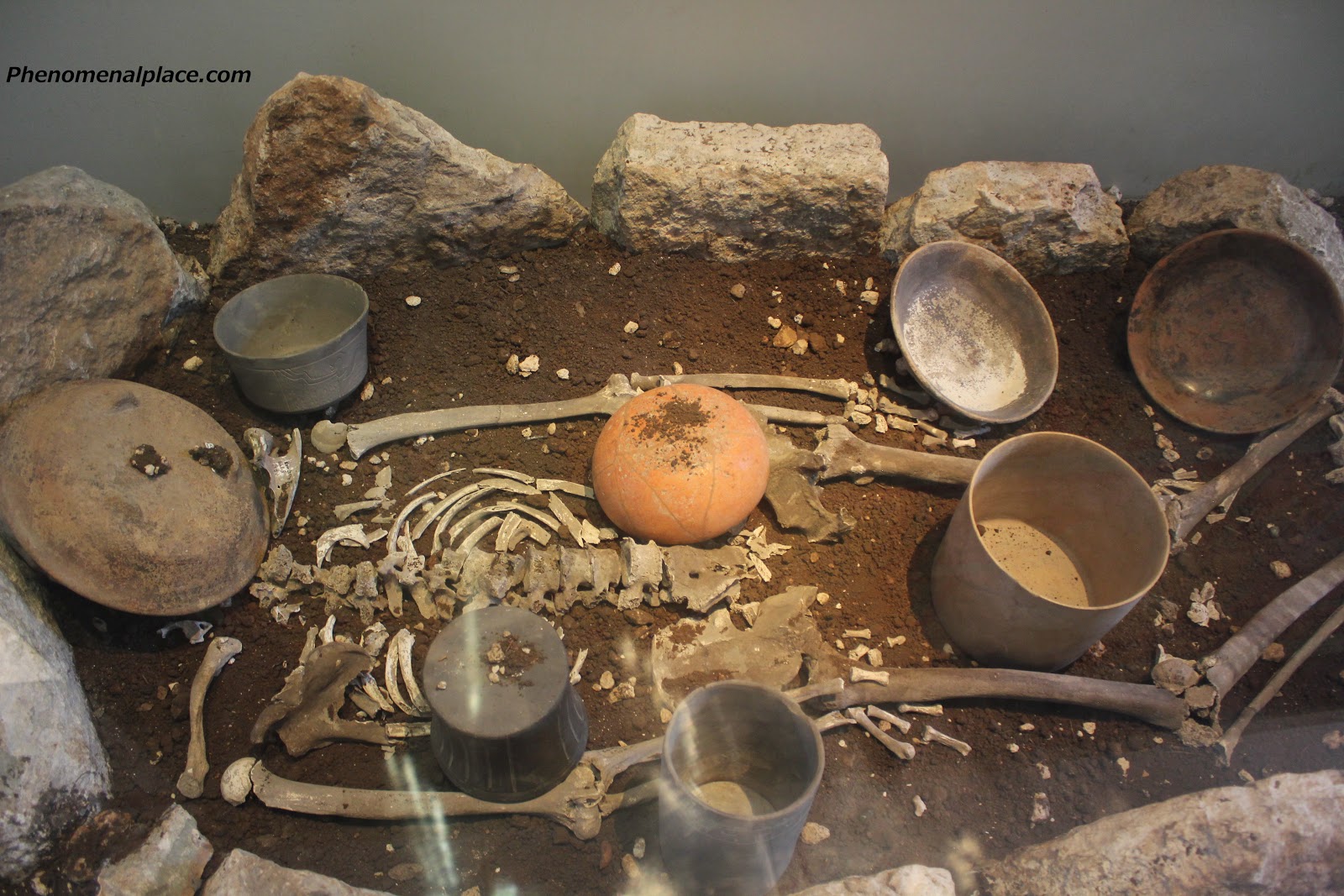
    Mayan Burial System:

    Ancient Mayans believed that death was merely a beginning of a journey which proceeded into the underworld (dark, watery cenote) and then you could be reborn as a heavenly creature if you defeated the underworld deities. So, the death rituals were carefully prepared for this risky journey. The dead were buried with utensils and other items they would need. If he had pet dogs, they would be buried along with him.


    Mathematical System of Mayas:

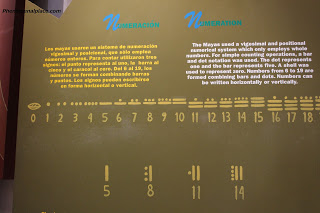
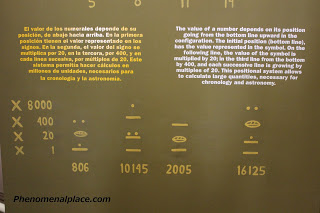
    The Mayans represented numbers with dots and bars. Dot represents one and the bar represents five.  Pretty simple eh? They also used a positioning system that goes bottom up . The numbers on the bottom were multiplied by 1 (confused?), the second line was multiplied by 20, and the third line was multiplied by 400 and so on. Simply put, the Mayans used base 20 also called vigesimal system. We use base 10 called decimal system. Click on the pictures below to learn Mayan math basics.
    Mayan Mathematical System Using Base 20 (vigesimal system)


    Other interesting details:
    • The Mayans domesticated dogs and used them for hunting.
    • They also grew honeybees for their honey.
    • They imported and exported various items, including raw materials from other countries.
    • Mayans had a complex system of writing which was developed before their classic period.
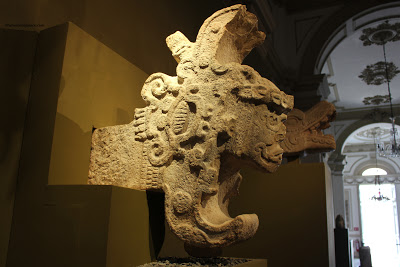
    Above: Kukulkan Emerges Out of The Serpent's Mouth

     Below: Virtual tour of Anthropology and History Museum:

    Share

    Twitter Delicious Facebook Digg Stumbleupon Favorites More